A businessman in a suit holding documents standing in front of a modern city hall building with construction cranes visible in the background against a blue sky
So you're ready to move forward with your property plans. Could be a simple garage addition. Could be transforming that vacant lot into a mixed-use building. Here's what typically derails things: you file your paperwork with the city, and three weeks later you're staring at a 47-page staff report explaining why your project violates codes you've never heard of, or you're sitting through a four-hour public hearing where neighbors describe your proposal as “the end of our community.”
Land use attorneys exist to prevent exactly these scenarios—and to fix them when they happen anyway.
What Is a Land Use Attorney and What Do They Do?
These lawyers specialize in the regulations governing what gets built where. They'll spend their Tuesday mornings arguing before planning commissions about whether your coffee shop needs 12 or 15 parking spaces, then spend afternoons drafting 30-page appeals explaining why city staff misinterpreted Section 18.45.060(b)(3) of the municipal code.
What is land use law? Start with every statute, ordinance, and administrative rule controlling property development. Zoning maps dividing cities into use districts. Subdivision regulations dictating how you split parcels. Historic preservation ordinances protecting old buildings. Environmental protection statutes requiring impact studies. Coastal zone management rules. Farmland preservation laws. Sign codes limiting billboard placement. The whole regulatory framework governing development falls under this umbrella.
Land use law vs zoning law: Zoning represents just one piece of the puzzle. Cities divide themselves into zones—R-1 residential, C-3 commercial, M-2 industrial, whatever naming system they've adopted. Every zone comes with a menu of permitted activities and dimensional standards. But land use law extends far beyond these district boundaries to include environmental regulations, subdivision controls, growth management policies, coastal protection requirements, wetland preservation rules, and architectural review standards. Think of zoning as one chapter in a much longer regulatory book.
Developers building shopping centers and apartment complexes hire these attorneys constantly. But the client list runs wider than you'd expect:
Homeowners fighting code enforcement notices about "illegal" home offices
Retailers converting houses into commercial storefronts
Ranch owners whose land just got rezoned agricultural-conservation
Cannabis entrepreneurs navigating specialized use permits
Telecom companies installing 5G equipment on existing towers
Churches expanding facilities in single-family neighborhoods
The work itself? Drafting permit applications that planning staff can't poke holes in. Standing before zoning boards during evening hearings to answer commissioner questions. Negotiating project conditions with city planners over lunch. Filing lawsuits when municipalities reject legally compliant proposals. Interpreting whether your project qualifies as "light manufacturing" or "general commercial use" under codes written in 1987.
Land use regulation has become extraordinarily complex, with overlapping federal, state, and local requirements. What appears to be a straightforward development proposal can trigger multiple review processes, each with specific procedural requirements and substantive standards. Experienced legal counsel is often the difference between project approval and costly delays or denials
— Michael Allan Wolf
When You Need to Hire a Land Use Attorney
Most folks realize they need help after their straightforward project suddenly isn't straightforward anymore. Here's when to call:
You're pursuing development requiring discretionary approval. Simple building permits work ministerially—plans comply with code, staff issues the permit, done. But once you need conditional use authorization, property rezoning, dimensional variances, or subdivision approval, you've entered discretionary territory where planning commissioners vote based on judgment calls. They'll hold public hearings, listen to neighbor complaints, debate your proposal's merits, and attach conditions. Showing up without legal representation puts you at a serious disadvantage.
The city denied your permit or approved it with deal-breaking conditions. Denials aren't always final. Unreasonable conditions aren't always mandatory. Attorneys evaluate your appeal prospects and push back against staff decisions. I've watched denials flip to approvals when lawyers resubmitted applications with proper documentation that staff somehow overlooked the first time.
Staff is interpreting codes in questionable ways. Municipal ordinances contain ambiguous language written by committee. Terms like "primarily used," "substantial change," and "harmonious design" mean whatever the reader thinks they mean. When planning staff reads provisions against your interests using strained interpretations, attorneys force the issue through administrative challenges or court petitions.
You've got organized neighborhood resistance. Developments attract opposition. Neighbor groups form coalitions, circulate petitions, pack hearing rooms wearing matching t-shirts, and sometimes hire their own counsel. They'll testify that your project will crater home values, gridlock intersections, and destroy community character—regardless of actual facts. Your attorney responds with evidence, technical experts, and legal standards that refocus decision-makers on code compliance rather than emotional testimony.
Your plans require conditional use authorization. Want to operate an event venue on agricultural land? Install solar arrays visible from the highway? Run a dog boarding facility in a residential area? These activities typically need conditional use permits. Standards are tougher than regular permits, and fumbling one application can prejudice future attempts.
You need dimensional relief through a variance. Your building plans require construction 8 feet from the side property line but setback rules mandate 15 feet. Your lot's unusual configuration, severe slope, or irregular dimensions might justify the variance. But legal standards are demanding—you can't just prefer the variance, your specific parcel must have unique physical traits creating genuine hardship. Attorneys know how to document required findings that variance-granting bodies actually want to see.
Environmental review is triggering complications. California projects hitting CEQA thresholds (or comparable state environmental laws elsewhere) enter a completely separate approval universe with distinct procedures, extended timelines, and substantial litigation risk. Environmental compliance can easily double your total project schedule. Attorneys manage the process and defend against near-certain lawsuits.
Author: Olivia Carringt;
Source: redmonpestmgt.com
Land Use Approval Process and Permit Requirements
The approval pathway changes based on jurisdiction and project characteristics, but you'll hit similar checkpoints regardless.
Understanding the Land Use Permit Application
Start by identifying which approvals your project actually needs. Small-scale construction might require only ministerial building permits that staff approves based on straightforward code compliance. Larger projects or unusual uses need discretionary permits involving official judgment calls.
Land use permit requirements begin with comprehensive documentation packages. Plan on submitting:
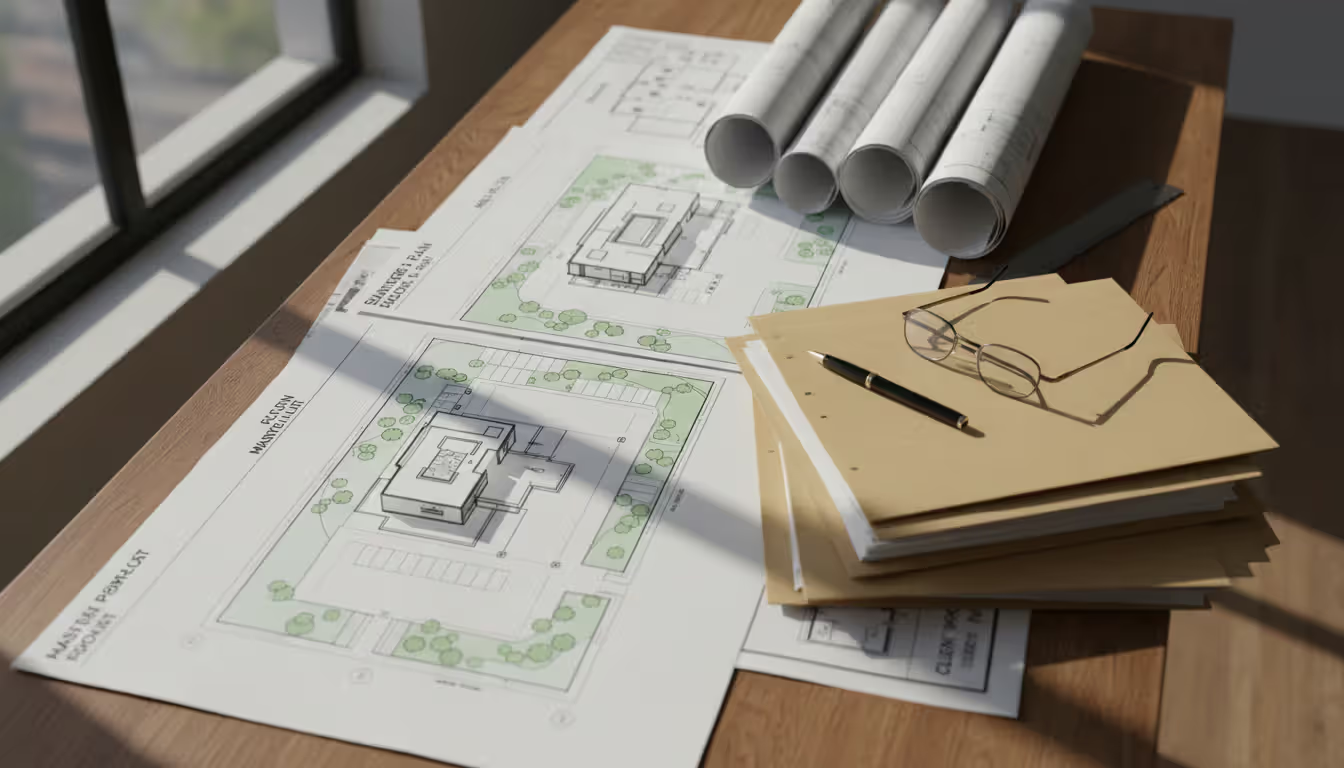
Scaled site plans depicting every structure, parking stall, driveway, and landscaped zone
Architectural drawings showing building elevations and floor layouts
Engineering studies covering grading plans, drainage systems, and utility connections
Narrative statements explaining how your proposal satisfies each approval criterion listed in the code
Staff routes your application through every relevant department for comments. Fire marshals verify emergency access. Public works engineers examine stormwater infrastructure. Environmental health divisions review septic capacity. Each department adds conditions to your approval.
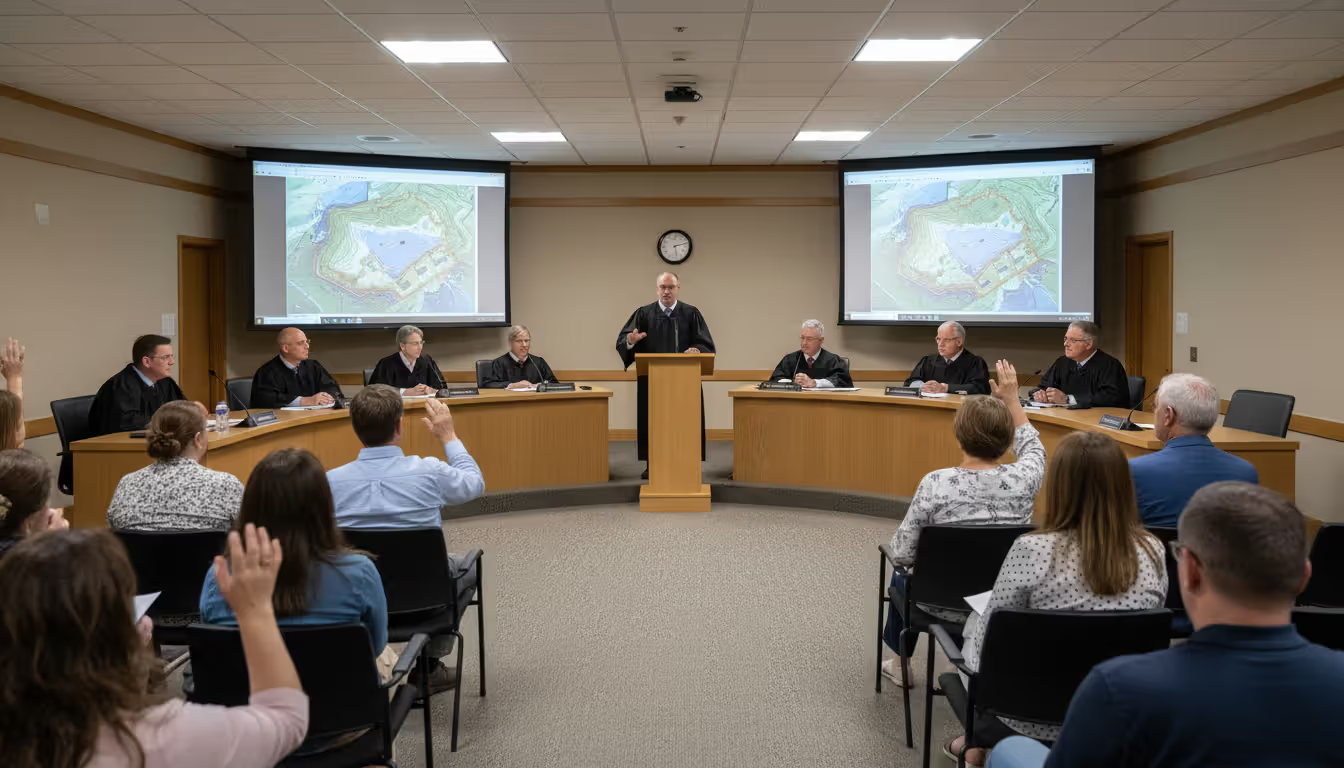
Next comes the staff report—a formal document recommending approval, conditional approval, or denial. This report goes to the planning commission or zoning board of appeals, who schedule public hearings. Nearby property owners receive mailed notice. Interested parties show up to testify. Commissioners ask questions, debate amongst themselves, and vote. Approved projects receive permits packed with conditions you'll satisfy before construction starts.
Sounds linear? Rarely works that way. Applications get returned for missing information. Neighbors demand continuances for additional hearings. Commissioners request supplemental studies. Your projected three-month timeline becomes eleven months.
Author: Olivia Carringt;
Source: redmonpestmgt.com
Conditional Use Permits Explained
Conditional use permits authorize activities that might work acceptably in particular zones but need case-by-case evaluation first. The regulatory logic: certain uses aren't automatically problematic but could become problematic depending on design specifics and operational details.
Real-world examples clarify this better than definitions. Houses of worship in residential zones generally need CUPs because Sunday services create traffic surges but churches typically make compatible neighbors. Fast-food restaurants with drive-through windows need CUPs in commercial districts because queuing cars create idling emissions and space conflicts. Cell towers, animal kennels, outdoor equipment storage, wedding barns—all common CUP candidates.
Approval standards typically require findings that your proposed use won't generate excessive negative impacts. Translation: you'll need to address traffic patterns, parking adequacy, noise generation, light trespass, visual compatibility, and consistency with the jurisdiction's long-range comprehensive plan.
Cities routinely impose operational conditions: limited business hours (7am to 9pm only), perimeter screening walls (minimum 6 feet), enhanced parking ratios (1 space per 200 square feet instead of the standard 1 per 300), prohibitions on outdoor amplified sound, annual compliance monitoring. Violate your CUP conditions and the city can revoke your permit entirely. Some municipalities require CUP renewals every five or ten years, forcing operators to prove they've honored all conditions and haven't created unforeseen problems.
Variance vs Special Exception in Land Use
Property owners confuse these constantly, but they're completely different approval mechanisms with different qualifying standards.
Approval Type
Definition
When You'd Use It
Approval Standard
Common Examples
Conditional Use Permit
Authorization for activities your zone permits conditionally rather than by-right
The activity appears on your zone's conditional use list
Show the use won't harm surrounding parcels and satisfies specific criteria the code establishes
Religious facilities, childcare centers, drive-through restaurants, wireless communication towers
Variance
Exception from dimensional or physical standards
Your specific parcel has unusual physical characteristics creating genuine hardship
Prove hardship stems from unique property conditions, not financial concerns or personal preferences
Reducing side setback on a pie-shaped corner lot; exceeding height maximums because of steep hillside terrain
Special Exception
Use permitted by-right once you verify compliance with specific conditions
The use is allowed but requires confirming you've met enumerated standards
Satisfy every condition the code specifies for that use category
Home-based businesses; accessory dwelling units; minor expansions to nonconforming structures
Variance vs special exception land use approval standards create huge practical differences. Variances demand proof of unnecessary hardship—meaning strict code enforcement prevents reasonable property use because of unique physical features your parcel possesses. Financial hardship doesn't count ("meeting the setback makes my project unprofitable" won't work). Self-created hardship doesn't qualify ("I subdivided this lot knowing it was undersized" fails). The land itself must have distinguishing characteristics—irregular geometry, excessive grade changes, geographic constraints—that separate it from neighboring properties.
Special exceptions follow clearer paths. The code lists specific preconditions. Meet every one, and approval becomes essentially mandatory with minimal discretion involved.
Concrete example: You want to construct a detached garage 5 feet from your side property line instead of the required 10-foot setback. If your lot measures just 40 feet wide (while typical lots in your neighborhood run 60+ feet), creating genuine hardship, you'd pursue a variance. If the code specifically permits reduced setbacks for accessory structures meeting particular size and height limitations, you'd file for a special exception.
How Land Use Attorneys Handle Disputes and Litigation
Conflicts erupt constantly in land use matters. Your neighbors organize opposition to your home addition. The planning director rejects your permit application. City council approves your development, then a citizens group files suit. Attorneys deploy different strategies depending on circumstances.
Resolution Method
Typical Timeline
Relative Cost
Success Rate
Best Situations
Direct negotiation with planning staff
2-8 weeks
$1,500-$5,000
60-70%
Technical compliance questions; minor design adjustments; code interpretation clarifications
Mediation
1-3 months
$5,000-$15,000
50-65%
Neighbor disputes over legitimate concerns; controversial proposals where middle-ground solutions exist
Direct negotiation happens throughout the approval journey. Attorneys communicate with planning staff constantly—clarifying what the application lacks, proposing design modifications satisfying code requirements, negotiating acceptable permit conditions. Many disputes dissolve when attorneys supply information staff didn't previously have or reframe proposals using code-compliant language.
Administrative appeals challenge unfavorable planning commission or zoning board decisions by appealing to city councils or specialized appellate bodies. The land use litigation process nearly always demands exhausting these administrative remedies before courts will hear cases. Appeals focus on procedural compliance (adequate public notice, impartial decision-makers, open meeting laws), correct legal application, and evidentiary support for required findings. Did commissioners follow proper procedures? Did they apply correct code provisions? Do their factual findings have substantial evidence supporting them in the administrative record?
Land use litigation means suing municipalities in court. Judges don't retry the entire case or second-guess policy judgments. They review whether the administrative decision was arbitrary and capricious, lacked substantial evidentiary support, violated mandatory procedures, or infringed constitutional protections. Common litigation theories include:
Procedural violations: Defective public notice, closed-session deliberations violating open meeting laws, financially interested decision-makers participating in votes
Substantive legal errors: Applying incorrect code sections, imposing conditions unrelated to actual project impacts, ignoring applicable approval standards
Constitutional violations: Regulatory takings eliminating all economically viable use, discriminatory treatment violating equal protection, content-based restrictions on protected speech
Winning in court requires building an airtight administrative record. That means raising every single argument during local hearings, preserving objections properly, submitting supporting evidence, and making explicit statements for the record. Courts review only what appears in the administrative record—you can't introduce fresh evidence or raise arguments you never mentioned locally.
Author: Olivia Carringt;
Source: redmonpestmgt.com
Land use dispute resolution sometimes involves inverse condemnation claims when regulations destroy property value. These constitutional cases require demonstrating the regulation eliminates all economically beneficial use—an extremely demanding standard. Partial value reduction isn't sufficient. You must show complete economic wipeout directly caused by regulatory restrictions.
CEQA Environmental Review in Real Estate Development
California's Environmental Quality Act creates an entirely separate regulatory layer stacked on top of standard land use approvals. CEQA environmental review real estate requirements apply statewide to discretionary governmental approvals, frequently adding months or years to project timelines.
CEQA mandates that state agencies and local governments examine environmental consequences before green-lighting projects. Agencies must identify significant environmental impacts and either avoid them entirely or implement mitigation reducing them to less-than-significant levels.
The process begins with exemption analysis. Categorical exemptions cover project categories that typically don't harm the environment—minor alterations to existing structures, replacement of existing facilities, accessory buildings under certain size thresholds. Statutory exemptions apply to legislatively designated project types like qualifying affordable housing developments in some circumstances.
Projects without valid exemptions get initial studies evaluating potential impacts across every environmental resource category. Finding no significant impacts produces a Negative Declaration. Finding impacts that feasible mitigation can reduce to insignificance yields a Mitigated Negative Declaration listing all required mitigation measures.
Projects causing unavoidable significant impacts require full Environmental Impact Reports—massive documents often exceeding 400 pages. EIRs analyze impacts to air quality, biological resources, cultural and tribal resources, energy, geology and soils, greenhouse gas emissions, hazards and hazardous materials, hydrology and water quality, land use and planning, mineral resources, noise, population and housing, public services, recreation, transportation, tribal cultural resources, utilities and service systems, wildfire, and mandatory findings of significance. They must evaluate reasonable project alternatives and feasible mitigation. Draft EIRs circulate for public review (45-day minimum comment period). Agencies must respond to every substantive comment received. Final EIRs go before decision-makers for certification.
CEQA compliance stretches timelines dramatically. Initial studies consume one to three months. EIRs require six to twenty-four months depending on project complexity and controversy levels. Public review periods, written comment responses, and certification hearings pile on additional time. Budget two years minimum for major projects requiring EIRs.
Attorneys navigate CEQA by:
Determining which exemptions might apply and preparing exemption documentation that withstands scrutiny
Hiring and managing environmental consulting firms preparing technical studies
Drafting responses to agency comments and public objections that address concerns without admitting fatal project flaws
Negotiating mitigation measures reducing impacts without rendering projects financially infeasible
Defending environmental documents against litigation (CEQA lawsuits are remarkably common—project opponents sue routinely claiming inadequate analysis)
Courts review environmental documents under an "abuse of discretion" standard, overturning agency environmental approvals only when the environmental analysis lacks substantial evidence or violates CEQA's mandatory procedures.
Smart CEQA compliance starts during initial planning phases. Conduct environmental studies while designing projects so you can incorporate mitigation into plans organically rather than awkwardly retrofitting solutions later. Engage stakeholders proactively and address their legitimate concerns early. Build comprehensive administrative records supported by credible expert studies. Otherwise, you'll face lawsuits halting construction and requiring costly supplemental environmental analysis running into six figures.
Author: Olivia Carringt;
Source: redmonpestmgt.com
How to Choose the Right Land Use Attorney
Selecting the right attorney often determines project success or failure. Here's what actually matters:
Local jurisdictional experience trumps everything else. Land use law is intensely local and political in practice. You need an attorney who knows your specific city or county intimately—someone who's actually read the entire municipal code (all 800 pages), understands the comprehensive plan's policy directives, recognizes planning staff members personally, and knows which planning commissioners care about what issues. An attorney appearing regularly before your local planning commission brings institutional knowledge that out-of-area lawyers simply cannot replicate. They understand staff's unstated preferences, which arguments resonate with particular commissioners, and how proposals should be strategically framed for that specific jurisdiction.
Look for proven experience with your project type. Ask about comparable projects they've handled. Residential developers benefit from attorneys experienced with tentative subdivision maps and residential density bonus calculations. Commercial developers need counsel comfortable handling traffic impact studies, parking requirement negotiations, and commercial design review processes. Specialized projects—cannabis retail dispensaries, wireless telecommunication facilities, deed-restricted affordable housing—demand attorneys who know those unique regulatory frameworks inside out.
Litigation capabilities matter even when you're hoping to avoid court. Your attorney should have genuine trial and appellate court experience. Municipalities take attorneys with successful litigation track records considerably more seriously during negotiations. The implicit threat of competent litigation strengthens your bargaining position substantially. Ask specifically about their win-loss record in land use administrative appeals and lawsuits.
Questions for your initial consultation:
How many applications have you personally handled in this specific city or county?
What approval percentage do you typically achieve for [conditional use permits/variances/rezonings] in this jurisdiction?
Who currently sits on the planning commission, and what concerns do they typically raise with projects like mine?
What timeline and cost range should I realistically expect for my project?
What factors could potentially derail my proposal, and how would you address those risks?
Will you personally handle my matter or assign it to associate attorneys?
Fee structures vary dramatically. Hourly billing rates for experienced land use counsel run $300-$650+ per hour depending on location and attorney reputation. Some firms offer flat fees for defined scopes—perhaps $7,500 for a conditional use permit application through the planning commission hearing. Complex projects sometimes involve monthly retainer arrangements. Understand precisely what's included versus what costs extra (expert witness fees, environmental consultant expenses, municipal application fees, appeal bond deposits).
Communication and responsiveness can't be overlooked. Land use approvals involve strict deadlines for submitting supplemental materials, responding to staff comment letters, filing administrative appeals. Your attorney must return calls promptly and keep you informed of developments. Clarify communication expectations during your initial meeting—will they email updates after every staff phone call? Provide weekly written status reports? Respond to emails within what timeframe?
Frequently Asked Questions About Land Use Attorneys
How much does a land use attorney cost?
Your budget depends heavily on project complexity and geographic location. Simple residential variance applications might cost $3,000-$8,000 in legal fees. Conditional use permits for moderately complex commercial projects typically run $8,000-$20,000 in attorney fees. Major development projects requiring comprehensive plan amendments, rezoning, subdivision approval, and environmental review frequently exceed $100,000 in cumulative legal costs. Add contested litigation and you're potentially looking at $50,000-$300,000+ for fully litigated cases through trial and appeals. Most attorneys charge $250-$500 for initial consultations where they'll assess your situation and provide realistic budget estimates. Remember these figures represent legal fees only—add environmental consultant costs, traffic study expenses, application fees, and other hard project costs.
What's the typical timeline from application to final approval?
Timelines fluctuate enormously based on jurisdiction and approval type. Simple area variances take three to six months from application submission to final decision. Conditional use permits typically consume four to eight months. Subdivision approvals run six to fourteen months. Add rezoning or comprehensive plan amendments and you're facing nine to eighteen months minimum. Projects triggering environmental review gain another six to twenty-four months for CEQA or equivalent state environmental law compliance. File an administrative appeal and tack on three to six months. Account for time preparing applications initially, addressing staff revision requests, and satisfying approval conditions before you can actually pull building permits. Complex projects commonly take two to three years from initial application filing to breaking ground.
Can I handle land use permits myself without hiring an attorney?
Nothing legally prevents you from self-representation. But your approval probability drops substantially for discretionary permits without professional legal representation. Ministerial building permits for straightforward, code-compliant construction rarely need attorneys—submit proper plans meeting code and staff must approve. Discretionary permits like conditional use authorizations, dimensional variances, and administrative appeals involve nuanced legal standards, procedural technicalities, and evidentiary requirements that trained counsel handles far more effectively. Consider this: municipalities employ professional planning staff and city attorneys protecting governmental interests. Why would you face them alone? Attorney fees almost always cost less than denial consequences, extended project delays, or approval conditions killing your project's financial feasibility. I've personally witnessed unrepresented applicants make procedural errors that permanently forfeit appeal rights or submit deficient applications that prejudice all future submission attempts.
What distinguishes a variance from a special exception?
Variances excuse you from dimensional or physical code requirements—minimum setbacks, maximum height limits, lot coverage caps—when your specific property possesses unusual physical characteristics creating genuine hardship. The approval threshold is demanding. You must prove hardship flows from unique physical features (irregular lot configuration, severe topography, size constraints different from neighborhood norms), not financial considerations ("meeting code makes my project unprofitable") or personal circumstances ("I prefer this design"). The hardship can't be self-created (you can't subdivide a parcel too small to meet minimum lot width, then request width variances). Special exceptions (called "special use permits" or "conditional use permits" in various jurisdictions) authorize uses that are conditionally permitted once you satisfy specific code criteria. The approval bar is lower—demonstrate compliance with enumerated conditions rather than proving unnecessary hardship. Practically: if the code lists specific prerequisites and meeting them gets you approval, that's a special exception. If you need relief from dimensional standards due to unique property-specific hardship, that's a variance.
When does appealing an unfavorable decision make sense?
Appeal when you have legitimate legal grounds: procedural defects (inadequate public notice, biased decision-makers violating due process), misapplication of governing code provisions, required findings lacking substantial evidentiary support in the record, or constitutional violations. Don't appeal simply because you're unhappy with the outcome or lost by one vote. Appeals consume serious money and several months minimum. Sometimes accepting denial and resubmitting a revised application proves smarter strategically than appealing. Negotiating modified approval conditions might serve your interests better than formal appeals. Consult an attorney immediately after unfavorable decisions—appeal filing deadlines are shockingly short, frequently just 10-20 calendar days. Miss that deadline and you've permanently forfeited appeal rights. Your attorney evaluates whether meritorious grounds exist and whether appealing makes strategic and financial sense given your specific circumstances.
Do I need an attorney for CEQA compliance?
For projects requiring full Environmental Impact Reports, hiring experienced counsel is absolutely essential. EIRs involve Byzantine procedural requirements, technical analyses across dozens of environmental resource categories, and serious litigation exposure. Even for projects potentially qualifying for categorical exemptions or Negative Declarations, attorney consultation prevents mistakes triggering lawsuits. CEQA litigation happens extraordinarily frequently—project opponents sue routinely, challenging environmental analysis and halting construction for years. I've watched multimillion-dollar developments stopped completely by CEQA lawsuits that could've been avoided with proper legal guidance during environmental review preparation. Investing in experienced CEQA counsel during the environmental process prevents vastly more expensive litigation problems later. Attorneys coordinate environmental consultant teams, ensure documents satisfy all legal requirements, craft comment responses that don't create new legal vulnerabilities, and defend against litigation challenging environmental document adequacy.
Land use regulations control what gets built where—regulations growing more intricate yearly. Whether you're developing a 200-unit multifamily complex, seeking approval for a home-based business, or contesting a zoning code violation notice, specialized legal counsel protects your interests and substantially improves approval odds.
The most successful projects bring attorneys in early—during initial conceptual planning, not after problems explode. Early involvement identifies regulatory obstacles before you've invested heavily, shapes proposals satisfying approval criteria from the start, and builds productive relationships with decision-makers. This proactive approach prevents denials, minimizes timeline delays, and reduces total project costs.
When hiring land use attorneys, prioritize local jurisdictional experience above all other factors. The attorney who practices regularly in your specific city or county brings knowledge and credibility that outside lawyers simply cannot match regardless of general experience levels.
Expect land use law to grow even more complicated as communities grapple with housing affordability crises, climate change adaptation requirements, aging infrastructure, and competing development pressures. Property owners and developers who invest in experienced legal representation early position themselves for success in an increasingly challenging regulatory environment.
Understanding timeshare law helps protect your rights and avoid costly mistakes. Learn about rescission periods, legal exit options including deed-back programs, maintenance fee obligations, foreclosure consequences, and protections against fraud. Discover what works and what doesn't when exiting a timeshare contract
Renting a home comes with legal protections most tenants never learn about until something goes wrong. When disputes with landlords escalate beyond informal resolution, understanding your rights and knowing when to hire specialized legal help can mean the difference between losing your security deposit and winning a substantial settlement
Property disputes require legal action when negotiations fail. This guide explains what real estate litigation attorneys do, common lawsuit types including breach of contract and specific performance, the litigation process, typical costs, and when mediation offers better outcomes than courtroom battles
The NAR settlement has millions wondering about compensation eligibility and payout amounts. Understanding your potential recovery requires knowing transaction specifics, timing, and how the commission structure worked during your home sale. This guide breaks down qualification criteria, calculation methods, and claim procedures
The content on this website is provided for general informational and educational purposes only. It is intended to explain concepts related to real estate law, property rights, leases, liens, zoning, landlord-tenant disputes, and litigation.
All information on this website, including articles, guides, and examples, is presented for general educational purposes. Legal outcomes may vary depending on jurisdiction, property type, and individual circumstances.
This website does not provide legal advice, and the information presented should not be used as a substitute for consultation with qualified attorneys or real estate professionals.
The website and its authors are not responsible for any errors or omissions, or for any outcomes resulting from decisions made based on the information provided on this website.