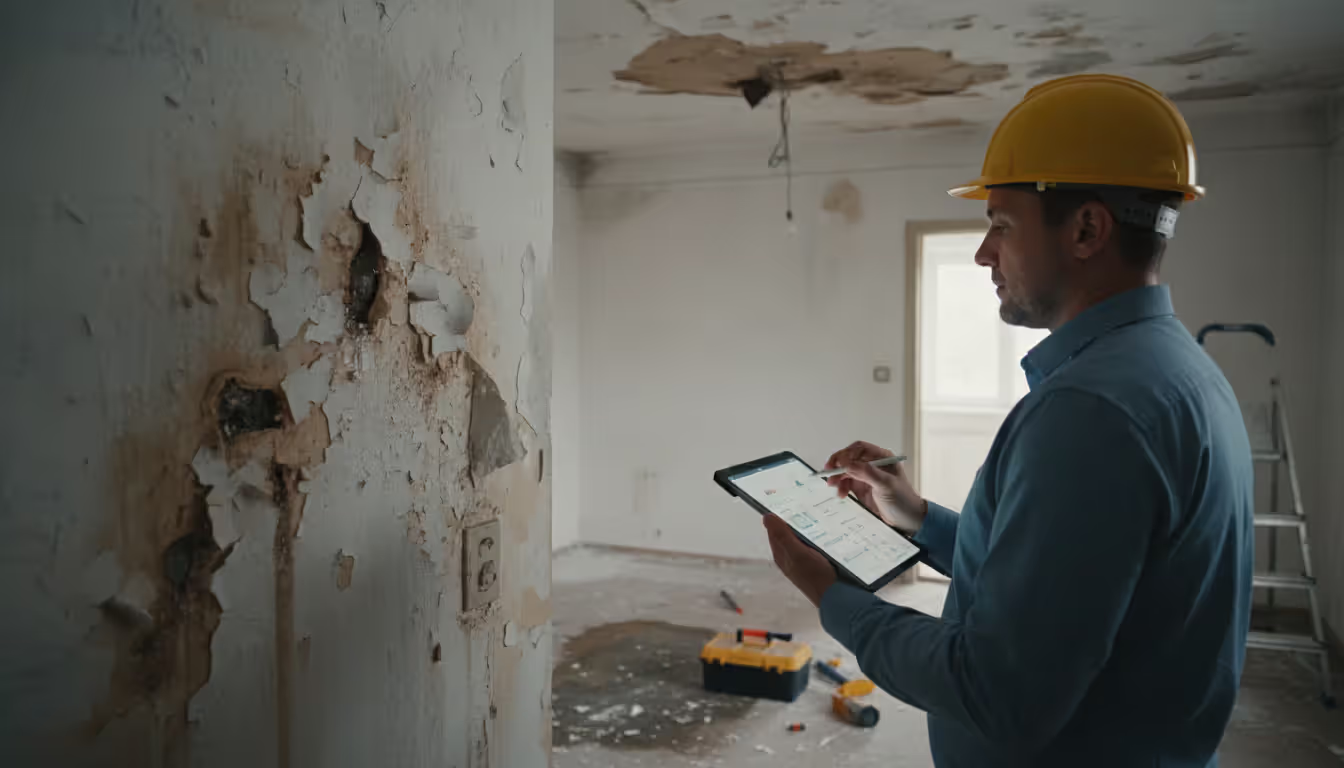
Picture this: it's mid-January, temperatures have dropped to 15 degrees, and your apartment's furnace died three weeks ago. You've called your landlord six times. You've sent two certified letters. Nothing. Meanwhile, you're running three space heaters and your electric bill just tripled.
What now? Keep sending that $1,200 rent check every month while you freeze? Or stop paying and probably get evicted within 30 days?
There's actually a third path most tenants don't know about. Rent escrow lets you keep making those monthly payments—just not to your landlord. Instead, you pay into a special court account while a judge forces your landlord to either fix the problem or face real consequences.
Here's what makes this different from just withholding rent: you're still paying. The court sees you acting in good faith. And you've got legal protection while the case moves through the system, which typically keeps eviction off the table.
Getting rent escrow right, though? That requires understanding exactly when you can use it, how the legal process actually works, and whether it beats your other options in your specific situation.
What Is a Rent Escrow Account?
Think of a rent escrow account as a holding pen for your rent money, controlled by the court rather than your landlord or you.
Here's how it functions: you file a legal case claiming your landlord's violated housing codes or broken the lease by letting the place fall apart. The judge says, "Okay, keep paying rent—but pay it to the court, not your landlord, until we sort this out." That money sits there, untouchable by either side, until the judge makes a final call.
This setup accomplishes two things at once. First, you prove you're not just trying to skip out on rent—you're still meeting your financial obligation every single month. Second, your landlord suddenly has a very strong motivation to fix that broken heating system or leaking roof, because they're not seeing a dime until they do.
The court clerk usually manages the account, though some jurisdictions appoint special administrators. Either way, it's not your money anymore and it's not your landlord's money—it's frozen until a judge decides what happens next.
Don't confuse this with your security deposit. That's money you paid upfront that your landlord holds to cover potential damage when you move out. Completely different animal. Rent escrow is a temporary legal tool you activate mid-tenancy when serious problems aren't getting fixed.
One more critical thing: rent escrow laws vary wildly depending on where you live. Maryland has detailed statutes laying out exactly how this works. Pennsylvania limits it to buildings with at least three units in certain cities. Some states barely recognize it at all, leaving tenants to figure out alternative legal theories. You've got to research your specific state and sometimes even your specific county or city.
Author: Olivia Carringt;
Source: redmonpestmgt.com
How Does Rent Escrow Work?
The mechanics involve paperwork, regular payments, and usually at least one court appearance. Let's break down each phase.
Filing a Rent Escrow Petition
Everything starts with filing legal documents at your local courthouse—could be district court, housing court, or landlord-tenant court depending on your area.
Your petition needs specifics. Not "my apartment has problems," but "the furnace broke on January 3rd, I notified the landlord in writing on January 4th and again on January 12th and January 20th, it's still broken as of today January 28th, and indoor temperatures have dropped to 52 degrees." List every code violation. Attach photos. Include copies of every email, text, and letter you sent the landlord.
Most courts want proof you gave your landlord reasonable time to fix things before you sued them. For non-emergencies—say, a slow leak under the sink—that might mean 30 days. For emergencies like no heat in winter or sewage backing up into your bathtub, you might file immediately.
Filing fees run anywhere from $25 to $150. Can't afford it? Most courts have fee waiver forms. You'll need to show proof of income (or lack thereof)—pay stubs, unemployment statements, food stamp verification, that kind of thing.
Many courthouses have self-help centers where staff (who can't give legal advice but can explain procedures) walk you through filling out forms. Legal aid offices sometimes handle these cases for free if you qualify income-wise.
Depositing Rent Into Escrow
Once the court accepts your petition, you're on the hook for depositing your full rent amount by your regular due date every single month. Not a day late. Not a dollar short.
Miss one payment? Your case gets dismissed. And now you're behind on rent with no legal protection, facing eviction for non-payment.
Courts have different payment systems. Some want checks or money orders made out to the court clerk. Others have online portals where you can pay electronically. Call the clerk's office and ask exactly how they want payment, then follow those instructions to the letter.
Save every receipt. Print confirmations of electronic payments. Keep a file folder with proof of every deposit, because if your landlord tries claiming you didn't pay, these receipts are your defense.
You'll pay the full contractual rent amount—if your lease says $1,500, you deposit $1,500. Some judges later reduce this if they find conditions were really terrible, but that happens after the hearing, not upfront. Don't just decide to pay less on your own.
The home is the center of everything. If you don't have a stable home, everything else falls apart. You can't hold a job, you can't keep your kids in school, you can't maintain your health. When tenants have legal tools to demand safe housing without losing their right to stay, that changes the entire power dynamic
— Matthew Desmond
What Happens After You File
The court schedules a hearing, usually 30 to 90 days out. They send official notice to your landlord informing them about your case and when they need to show up.
During this waiting period, you keep making monthly escrow deposits. Every. Single. Month.
Some landlords fix everything immediately once they realize their rent's frozen. If your landlord completes the repairs and you confirm the work's acceptable, the court usually releases all the escrowed money to the landlord and closes your case. Everybody moves on.
Other landlords fight. They file responses claiming you're lying about conditions, or you broke the furnace yourself, or they already fixed it, or the lease says they're not responsible for that particular repair.
While you wait for your hearing date, gather evidence like your life depends on it. Take dated photos every few days showing ongoing problems. Get written statements from neighbors who've seen the conditions. Request an official inspection from your city or county code enforcement office—those reports carry serious weight with judges. Keep a journal documenting how the problems affect your daily life (missed work because you had no heat, medical bills from mold-related respiratory issues, whatever applies).
Some courts send their own inspectors to check out the property. These official inspections often determine the whole case outcome.
Author: Olivia Carringt;
Source: redmonpestmgt.com
When Can a Tenant Use Rent Escrow?
You can't use rent escrow just because your landlord's annoying or because you want a rent reduction. Courts reserve this remedy for serious problems that actually make your place unsafe or unlivable.
What qualifies? Here's what typically makes the cut:
Essential services cut off: No heat when it's freezing outside. No running water. No electricity—assuming your landlord's responsible for it (like they didn't pay the utility bill for common areas in a multi-unit building, or the building's electrical system is broken).
Major structural failures: Your roof leaks so badly it's ruining your ceiling and walls. Windows are broken and won't close. The floor's literally collapsing in spots. The front door frame's so damaged it won't lock.
Health hazards landlords won't address: Mold spreading across walls from water damage your landlord never fixed. Rat or roach infestations the landlord refuses to treat properly. Lead paint hazards in units with young children.
Building code violations: Bathrooms or kitchens that don't meet code. Missing smoke detectors or carbon monoxide alarms. Electrical wiring that violates fire safety codes. Exits that are blocked or don't meet requirements.
Security problems: Exterior door locks that are broken. Security gates or systems promised in your lease that don't work.
Here's what typically doesn't qualify: Cosmetic stuff like scuffed paint or worn carpets. Minor inconveniences like a slow-draining sink or a cabinet door that sticks. Your landlord refusing to upgrade to nicer appliances. Things you or your guests broke.
That last point matters hugely. If you caused the damage—whether accidentally or on purpose—you can't use rent escrow to force repairs. Your landlord will argue you created the problem at the hearing, and if they prove it, you lose.
State and local laws add another layer of complexity. Take Maryland—they've got detailed statutes defining "dangerous or unhealthy" conditions that justify rent escrow. Pennsylvania's law only applies to buildings with three or more apartments in certain municipalities. New York's approach differs from California's approach differs from Texas's approach.
Timing also affects eligibility. Generally, you need to: still be living in the unit (you can't move out then file), be current on rent when you file (though some places allow it even if you're behind), have given written notice to your landlord, and have allowed reasonable time for repairs before filing.
Rent Escrow vs Other Tenant Remedies
When your landlord won't fix serious problems, you've got several potential moves. Each comes with different risks and benefits.
Rent Escrow vs Rent Withholding
Rent withholding means exactly what it sounds like—you just stop paying rent until your landlord makes repairs.
Some states explicitly allow this under their implied warranty of habitability laws. Others forbid it entirely. Even in states that theoretically permit it, the practical reality gets messy fast.
Here's the fundamental difference: With rent escrow, you're actively making payments every month—just to the court instead of your landlord. You've got a judge supervising everything. You're protected from eviction as long as you keep making those escrow deposits. You're the one who initiated legal action, putting you in the driver's seat.
With rent withholding, you've got nothing. No court supervision. No formal protection. You're just... not paying. And your landlord can file eviction for non-payment within days.
Sure, you can raise habitability problems as a defense in eviction court. But now you're playing defense instead of offense. You're already facing eviction proceedings. Even if you eventually win, you've been through eviction court—and that creates a record that shows up when future landlords run tenant screening reports.
The eviction risk with withholding is real and immediate. Landlords file non-payment evictions quickly—sometimes within five days of a missed rent payment. You're suddenly fighting to keep your home while also trying to prove your habitability claims.
Rent escrow flips this dynamic. You file first. You're still paying. You've dramatically reduced your eviction risk (though landlords can still try evicting you for other reasons, like lease violations).
Some tenants try a hybrid approach—withhold rent initially, then when they file their escrow petition, deposit all the withheld rent into the escrow account to catch up. This can work if you move fast, but every day you withhold without court protection leaves you vulnerable.
Rent Escrow vs Repair and Deduct
Repair and deduct laws (where they exist) let you hire someone to make repairs yourself, pay them, then subtract that cost from your next rent payment.
This works great for certain situations. Your exterior door lock breaks, making your place insecure. You get a locksmith to replace it for $175. You pay the locksmith, keep the receipt, and pay $175 less rent that month.
Fast. Simple. No courts. No waiting.
But repair and deduct has serious limitations. Most states cap how much you can deduct—often one month's rent or $500-$1,000, whichever is less. You can usually only use it once or twice per year. And if you mess up the procedure—hire an unlicensed contractor, don't give proper notice, deduct more than the actual cost—your landlord can evict you for non-payment.
Repair and deduct fails completely for expensive problems. Your HVAC system dies and replacement costs $4,500? Can't repair and deduct that. Your roof needs $8,000 in repairs? Nope. These situations need rent escrow, where the court can order your landlord to complete expensive repairs or authorize using months of accumulated escrow funds to pay contractors.
Rent escrow also provides remedies repair and deduct can't touch. A judge might reduce your rent retroactively for past months you lived with terrible conditions. Courts can order ongoing supervision, requiring your landlord to complete specific work by specific deadlines with follow-up inspections. You can't get any of that through repair and deduct.
On the flip side, repair and deduct resolves problems in days or weeks when it works. Rent escrow takes months. For a $200 repair that falls within statutory limits and you've got a licensed contractor ready to do the work, repair and deduct makes more sense than a three-month court battle.
Remedy Option
How You're Protected
Do You Need Court Approval First?
Could You Still Face Eviction?
How Long Until Resolution?
When This Makes Most Sense
Rent Escrow
Court supervises the entire process and holds your payments
Yes—file petition before depositing to escrow
Low risk if you make all deposits on time
Usually 2-4 months
Landlord ignoring serious violations, repairs cost thousands, you need court leverage
Rent Withholding
Minimal—only your habitability defense if evicted
No court filing required initially
Very high—landlord can file eviction immediately
Unpredictable—depends entirely on landlord's response
Your state clearly permits it AND you're prepared to defend yourself in eviction court
Repair and Deduct
Statutory right in about half of states
No court involvement needed
Moderate—landlord might dispute your deduction
Repairs done in 1-2 weeks typically
Problem costs under your state's cap, you can find licensed contractors quickly, issue is straightforward
How Landlords Respond to Rent Escrow
Landlords' reactions to escrow petitions fall into several predictable categories.
Quick compliance. Some landlords, especially smaller operators who rely on monthly rent to cover their mortgage, fix everything immediately. They can't afford frozen rent for months. They get served with your petition, call a contractor that afternoon, and have repairs done within two weeks. If you confirm the work's satisfactory, the court releases all escrowed funds and closes the case. Everyone's happy.
Aggressive fighting. Other landlords come out swinging. They file detailed responses denying everything, hire attorneys, show up at hearings with their own evidence. They might bring photos trying to show conditions aren't that bad, or receipts claiming they already made repairs, or lease clauses arguing they're not responsible for certain maintenance. These landlords often have property managers or legal teams who handle multiple escrow cases and know the system.
Retaliation attempts. Some landlords get vindictive. They file eviction for nitpicky lease violations you've technically committed—like having a pet when the lease says no pets, even though they've known about your cat for two years and never cared. Or they refuse to renew your lease when it expires. Or they suddenly start strict enforcement of rules they previously ignored.
Most states prohibit retaliation against tenants exercising legal rights. If your landlord files eviction within 90-180 days of your rent escrow filing (exact timeframes vary), you can raise illegal retaliation as a defense. Document everything—dates, actions, any statements your landlord makes. "You filed that court case, so I'm not renewing your lease" is basically handing you a winning retaliation claim.
Parallel eviction filings. Some landlords file eviction for non-payment even though you're depositing rent into escrow. This is usually a pressure tactic or confusion about the law. You respond by showing up to eviction court with all your escrow deposit receipts proving you've paid. Judges typically dismiss these eviction cases quickly, though the process wastes your time and creates stress.
Strategic delays. Certain landlords request continuances, file motions, drag out the process hoping you'll give up or move out. Every month you're in escrow is another month they're not getting rent, but some calculate that fighting costs less than making expensive repairs.
Once a judge orders repairs, timelines vary. For emergencies—no heat, sewage backups, electrical hazards—courts might order fixes within 7-14 days. For serious but non-emergency violations, 30-60 days is common. Minor issues might get 90 days.
Landlords who ignore court-ordered repair deadlines face escalating consequences. The judge might hold more funds in escrow longer, impose daily fines ($50-200 per day), appoint a receiver to take over property management temporarily, authorize you to use escrowed funds to hire contractors yourself, or hold them in contempt of court (which can mean jail time in extreme cases).
Author: Olivia Carringt;
Source: redmonpestmgt.com
The Court Process and Releasing Escrow Funds
Your hearing day arrives. Both sides show up (hopefully—sometimes landlords don't appear, which usually means you win by default).
You present your evidence first since you filed the case. Bring everything: printed photos with dates visible, copies of all written communications with your landlord, code enforcement inspection reports, contractor estimates showing repair costs, medical records if health impacts occurred (like emergency room visits for carbon monoxide exposure or respiratory problems from mold), testimony from witnesses who've seen the conditions.
Your landlord presents their counter-evidence. Maybe photos showing they already fixed things, or receipts for repair work they claim they completed, or arguments that conditions don't actually violate any codes. They might bring expert witnesses—their own inspector or contractor who'll testify conditions are acceptable.
Judges evaluate several questions: Do actual code violations or habitability defects exist? Did the landlord get proper notice and reasonable time to fix things before you filed? Are the problems serious enough to justify escrow? Did you cause or contribute to the damage?
Different judges emphasize different factors. Some are tenant-friendly and rule for tenants unless landlords prove total compliance. Others scrutinize tenant claims heavily and rule for landlords if violations seem minor.
If you win, the judge typically orders: specific repairs with deadlines, continued escrow of future rent until repairs are verified complete, sometimes retroactive rent reductions (meaning you get refunded some escrowed money or it's credited to future rent), and sometimes payment of your court costs or attorney fees if you hired a lawyer.
The judge might schedule follow-up hearings 30-60 days out to verify repair completion, or require your landlord to submit proof (inspection reports, contractor certifications, photos).
If your landlord wins, the court releases all escrowed funds to the landlord immediately. You resume paying rent directly to them. You've still got the protections of living in a habitable place under general law, but this specific escrow case is over.
Partial victories are common. Maybe the judge finds your landlord violated codes on three out of five items you claimed. They order those three things fixed, release 60% of escrowed funds for the months when only partial violations existed, and hold 40% until repairs are done. Real cases rarely break perfectly for either side.
Fund release mechanics depend on the court's order. For landlords, release usually requires proof: a city inspector signs off that violations are corrected, or the landlord submits receipts and photos and you confirm everything's fixed, or the judge conducts a brief follow-up hearing where both sides report on repair status.
For tenants receiving rent reductions, the court might refund money directly (you get a check), credit it against future rent (your next two months are free), or split escrowed funds between you and the landlord based on percentage calculations.
Start to finish, figure two to six months for straightforward cases. Complex situations with multiple properties, extensive violations, or appeals can drag on longer. Emergency cases involving immediate dangers sometimes get expedited hearings within days or weeks.
Author: Olivia Carringt;
Source: redmonpestmgt.com
Frequently Asked Questions About Rent Escrow
Can I be evicted for using rent escrow?
Evicting you specifically because you filed rent escrow is illegal retaliation in most states—your landlord can face penalties for it. But here's the catch: you can still be evicted for legitimate reasons unrelated to the escrow case. If you fail to make your monthly escrow deposits on time, that's non-payment and you're vulnerable. If you violate other lease terms—unauthorized occupants, disturbing neighbors, property damage you caused—those can support eviction even while your escrow case is pending. The key is keeping up with every escrow deposit by the deadline. Those receipts prove you're paying rent, blocking non-payment evictions. If your landlord files eviction shortly after your escrow petition and you can't identify any legitimate lease violation you committed, document that timing carefully—could be illegal retaliation you can fight.
How much does it cost to file a rent escrow case?
Court filing fees typically run $25-150 depending on your jurisdiction and which court handles landlord-tenant cases in your area. Can't afford it? Almost every court has fee waiver applications for low-income tenants. You'll need documentation—recent pay stubs, unemployment statements, SNAP/food stamp letters, whatever proves your income level. Beyond the filing fee, budget for: process server fees if you need someone to officially deliver papers to your landlord ($20-50), though many courts let you use certified mail for less. Code enforcement inspections are usually free through your city or county. Copying and organizing evidence costs a few dollars. Attorney fees if you hire one (many tenants handle these cases themselves, but lawyers cost $150-400/hour if you go that route). Some legal aid organizations handle rent escrow cases for free if you qualify income-wise.
Do I still pay rent during the escrow process?
Absolutely yes—you pay full rent every single month into the court escrow account by your normal due date. This is not a rent vacation. The escrow process redirects where your rent goes (court instead of landlord), but doesn't eliminate your payment obligation. Miss one payment or pay late? Your case gets dismissed and you're suddenly behind on rent with no legal protection, facing non-payment eviction. Courts take payment deadlines seriously. Some judges dismiss cases immediately upon a single missed deposit. Set phone reminders. Mark your calendar. Treat escrow deposits like you'd treat any other crucial bill. Save every receipt or payment confirmation—if your landlord later claims you didn't pay, those receipts are your only defense.
What repairs qualify for rent escrow?
Serious habitability defects and housing code violations qualify—think problems that actually affect safety, health, or your ability to use the space as a residence. Specific examples that typically work: no heat when weather's cold, no water or hot water, sewage backing up or plumbing completely failed, roof leaking badly enough to damage interior spaces, broken windows that won't close or lock, mold growth from water damage the landlord won't fix, pest infestations (rats, roaches, bedbugs) the landlord refuses to treat, broken exterior locks making the place insecure, no working smoke detectors, electrical hazards or non-functioning electrical systems, exposed lead paint with children present. What doesn't qualify: cosmetic problems like worn carpets or faded paint, minor inconveniences like a slow drain or a sticky window, appliance upgrades you want but aren't safety issues, damage you or your guests caused. The litmus test: does this violate housing codes or make the place substantially unlivable? If yes, probably qualifies. If it's just annoying or ugly, probably not.
How long does the rent escrow process take?
From filing your petition to getting a first hearing: usually 30-90 days depending on how backed up your local court is. If your landlord fixes everything before the hearing and you confirm the repairs are good, figure 60 days total and you're done. Contested cases where landlords fight your claims stretch to 3-6 months typically—initial hearing, maybe the judge orders an inspection or repairs, follow-up hearing to verify completion, final distribution of funds. Complex situations with lots of violations or multiple properties can extend further. Appeals add months or years, though these are rare in rent escrow cases. Emergency situations involving immediate health/safety dangers sometimes get fast-tracked—judges can schedule hearings within days or a couple weeks when circumstances warrant. But bank on 2-4 months as typical for a case that goes through the full process.
What happens if the landlord doesn't make repairs?
Judges have serious enforcement tools for non-compliant landlords. The escrowed funds stay frozen—your landlord gets nothing until repairs are done, which can mean months without rental income. Courts can authorize you to use escrowed money to hire contractors yourself to make repairs, essentially letting you spend your landlord's money on fixing their property. Judges impose daily fines, often $50-200 per day for every day past the repair deadline, which accumulates fast. In extreme cases, courts appoint receivers—third parties who take over property management, collect rents from all tenants, hire contractors, make repairs, and run the building until violations are fixed. Contempt of court citations can result if landlords completely ignore court orders, potentially meaning jail time (though this is rare). Rent reductions can continue indefinitely—if your rent's normally $1,500 but the judge reduces it to $800 until repairs happen, that reduction stays in effect until your landlord complies. Basically, courts have leverage to force compliance if they choose to use it.
Rent escrow works as a powerful legal tool when you're stuck with serious habitability problems and a landlord who won't respond to normal requests. It protects your housing while forcing action through official channels—you're still paying rent, you're acting in good faith, and you've got court supervision backing you up.
But this remedy demands follow-through. You can't just file paperwork then forget about it. You're committing to: documenting violations thoroughly with photos, written records, inspection reports; sending proper written notice to your landlord before filing; completing court forms correctly and attending all hearings; making full rent deposits to escrow on time every single month for however long the case takes; gathering evidence and possibly testifying in court.
These requirements take effort, but they create legal protections that informal approaches can't match. Simply withholding rent leaves you exposed to immediate eviction. Rent escrow, done right, shields you while your case proceeds.
When does rent escrow make the most sense? You're facing expensive repairs your landlord refuses to make despite repeated requests. The problems are serious—code violations, safety hazards, conditions making the place unlivable. You've got documentation proving you notified your landlord and gave them reasonable time. You can commit to monthly escrow deposits for several months. You're willing to participate in court proceedings. Your state or city actually has rent escrow procedures (not everywhere does).
For minor problems or situations where quick fixes costing under $500 would solve everything, repair and deduct might work better—faster resolution, no court involvement. For tenants in states with strong withholding laws who understand eviction risks, that approach might be simpler, though personally I'd almost always choose escrow's legal protection over withholding's vulnerability.
Before choosing any remedy, research your local laws carefully. Rent escrow procedures vary dramatically between jurisdictions. Maryland's process differs from Pennsylvania's differs from California's. Some cities have their own specific procedures even within states. Your county bar association, local legal aid office, tenant union, or court self-help center can clarify what's available where you live.
Don't file rent escrow impulsively or out of anger at your landlord. Evaluate realistically: Are violations actually serious enough for court? Did you give proper notice and adequate repair time? Can you handle monthly deposits for months? Are you prepared to gather evidence and go to hearings? Is this really worth the time and effort compared to just moving?
When circumstances align—serious violations, documented landlord non-response, your ability to follow through—rent escrow accomplishes what informal complaints never could. It creates legal accountability. It forces landlords to meet basic habitability standards. And it protects your tenancy while making that happen, giving you leverage you wouldn't have otherwise. For tenants caught between paying full price for a deteriorating apartment and risking eviction by withholding payment, rent escrow opens a third path that protects both your rights and your home.
Property taxes in land contracts confuse many buyers and sellers. While contracts typically assign responsibility to buyers, sellers remain legally liable until the deed transfers. Understanding this split obligation and the consequences of unpaid taxes is critical for protecting your investment
A sublease agreement creates a legal bridge between your existing lease obligations and someone else's temporary housing needs. Understanding the three-party relationship, securing landlord approval, and drafting comprehensive agreements protects your security deposit and rental history
A residential lease agreement creates legally binding obligations for both tenants and landlords. This comprehensive guide explains standard lease clauses, rights and responsibilities, security deposit rules, renewal processes, subletting options, and how to break a lease legally while avoiding costly mistakes
Persistent noise, odors, or encroachment from neighbors can cross the line into legal nuisance. Understand what qualifies as actionable nuisance under US law, the difference between private and public nuisance, and the legal steps to resolve disputes—from documentation to court remedies
The content on this website is provided for general informational and educational purposes only. It is intended to explain concepts related to real estate law, property rights, leases, liens, zoning, landlord-tenant disputes, and litigation.
All information on this website, including articles, guides, and examples, is presented for general educational purposes. Legal outcomes may vary depending on jurisdiction, property type, and individual circumstances.
This website does not provide legal advice, and the information presented should not be used as a substitute for consultation with qualified attorneys or real estate professionals.
The website and its authors are not responsible for any errors or omissions, or for any outcomes resulting from decisions made based on the information provided on this website.