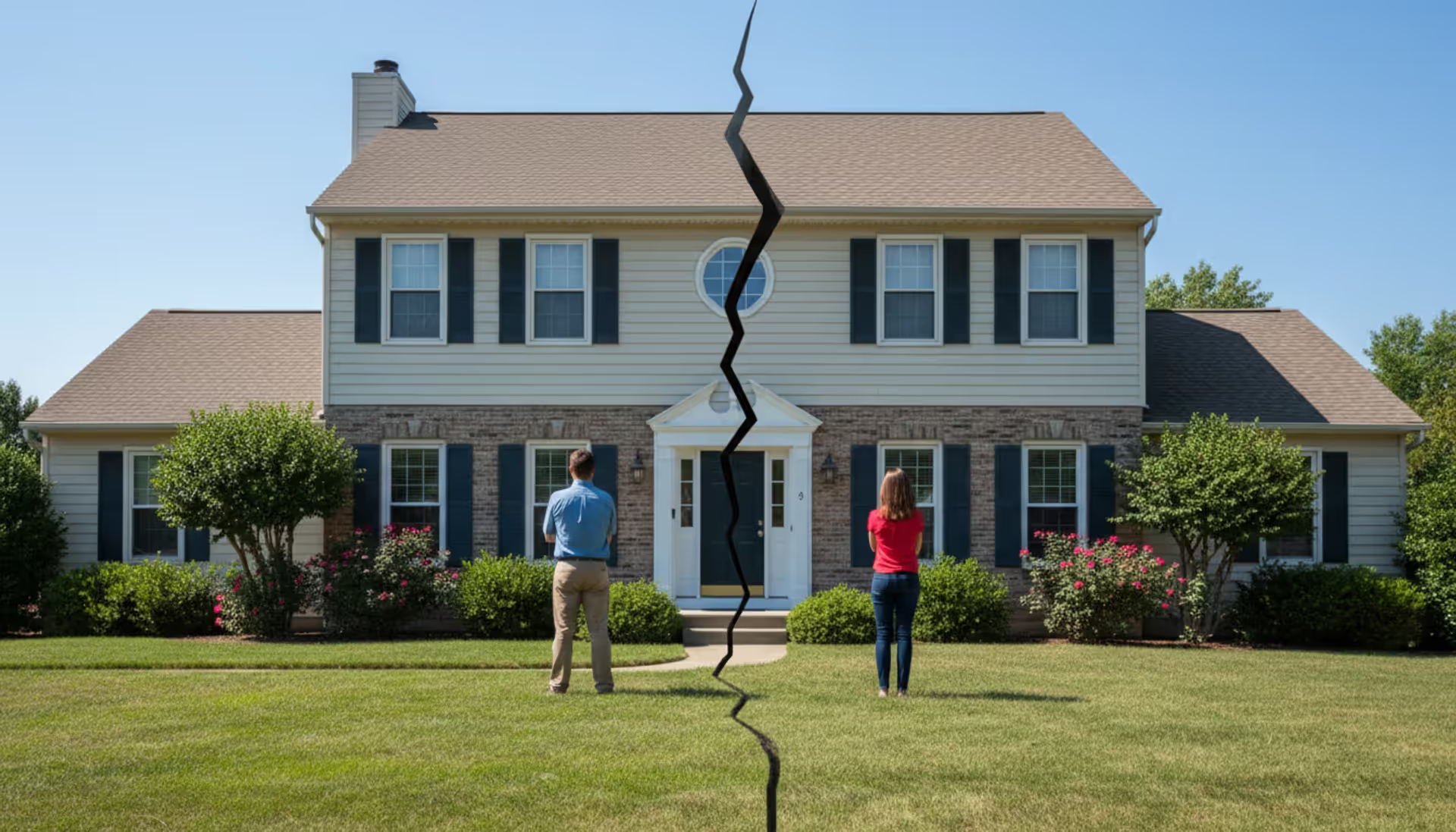
A suburban house visually split in half by a crack with two co-owners standing on opposite sides with arms crossed, symbolizing a property partition dispute
Property co-ownership falls apart more often than you'd think. Maybe you and your two brothers inherited your parents' lake house, but one wants to sell immediately while another dreams of keeping it in the family forever. Perhaps your business partner decided to retire, leaving you stuck sharing commercial real estate with someone who's checked out completely. Or your ex-girlfriend still owns half your condo even though she moved to another state two years ago.
When you can't agree on what to do with shared property—and you've exhausted every conversation, argument, and awkward family dinner trying—partition actions offer a legal exit strategy. Think of it as the last resort that lets any co-owner force a property split or sale through the courts.
What Is a Partition Action?
Here's the straightforward definition: a partition action is a lawsuit where someone who co-owns property asks a judge to either physically divide that property into separate pieces or order its sale. You're essentially telling the court, "We can't agree, so please step in and end this stalemate."
Every state in America recognizes partition rights. The reasoning goes back centuries: property ownership should be voluntary. If you want out of a co-ownership situation, you shouldn't be stuck forever just because the other owners refuse to sell or buy you out.
State laws spell out exactly how partition works through statutes, though the details shift depending on where your property sits. California's process differs from Florida's, which differs from New York's. But the core principle stays consistent—courts treat partition as nearly an absolute right. Judges can't just say "no" because they think you should work it out yourselves. If you qualify as a co-owner and follow the rules, partition typically happens.
You'll see partition lawsuits pop up in predictable situations:
When families inherit property together: Three sisters inherit dad's house. Sister A lives across the country and needs her inheritance money now to pay medical bills. Sister B lives locally and wants to move into the house. Sister C thinks they should rent it out for passive income. Nobody budges. After a year of circular arguments at Thanksgiving, Sister A files for partition.
After business relationships end: Two partners bought a small office building together in 2015. By 2023, one partner wants to retire and move to Arizona. The other wants to keep running his consulting business from that building. The retiring partner needs to cash out his real estate investment. Months of negotiations go nowhere. Partition lawsuit gets filed.
When couples split up: Unmarried couples buy property together all the time. When they break up, things get messy. Unlike married couples who divide assets through divorce court, unmarried ex-partners need partition actions. One person usually can't afford to buy out the other, and neither wants to keep co-owning with their ex.
Investment disputes among friends: Four college buddies pooled money to buy a rental duplex as an investment. Ten years later, their lives have diverged completely. Two want to sell at the market peak. Two want to hold long-term. The stalemate drags on for years until someone finally lawyers up.
The key advantage? You don't need everyone's agreement. Even if you own 20% and the other four owners (controlling 80% collectively) all oppose you, you can still force action through partition. That's the legal safety valve preventing co-owners from being trapped permanently.
Author: Olivia Carringt;
Source: redmonpestmgt.com
Who Can File a Partition Action
Not every type of property co-ownership qualifies for partition. Your ability to force a split or sale depends entirely on how you hold title.
Tenants in common have the clearest path to partition. This ownership type means each person owns a specific percentage—maybe 50-50, maybe 25-75, maybe four people each owning 25%. There's no "right of survivorship," so if one owner dies, their share goes to their heirs, not the other co-owners. Each tenant in common can sell their slice, mortgage it, or demand partition. Courts virtually never deny partition to tenants in common.
Joint tenants can also file for partition, though doing so breaks the joint tenancy structure. Joint tenancy includes that survivorship feature—when one joint tenant dies, the survivors automatically absorb that person's share. Filing for partition destroys this arrangement and converts everyone to tenants in common. But yes, joint tenants can absolutely force partition if they want out.
Tenants by the entirety face major restrictions. This special ownership form exists only for married couples in certain states (not all states recognize it). While married, neither spouse can unilaterally partition the property. The ownership functions as one indivisible unit. You'd need to get divorced first, which converts the ownership to something partitionable (or you'd divide it through divorce proceedings instead).
Community property in states like California, Texas, and Arizona has its own rules for married couples. During marriage, partition actions typically don't work—you'd handle property division through divorce court if the marriage ends.
Here's something that surprises people: your ownership percentage doesn't matter for filing rights. Own 5% of a property while someone else owns 95%? You can still file for partition. The percentage affects how much money you receive from a sale, but not whether you can force that sale to happen in the first place.
A few exceptions will block partition rights:
Signed contracts agreeing not to partition for a specific time period (we'll discuss these more later)
Certain trust arrangements that prohibit partition
Specific agricultural land protections in some states
Conservation easements or deed restrictions that prevent division
Life estate situations where one person has lifetime rights
Sometimes creditors get involved too. If someone gets a judgment against your co-owner and places a lien on their property interest, that creditor might file a partition action themselves to force a sale and collect from the proceeds.
Partition in Kind vs Partition by Sale
Judges have two main tools for resolving partition cases: cutting the property into pieces or forcing everyone to sell. The approach chosen dramatically changes outcomes for everyone involved.
Partition in Kind Explained
Physical partition—lawyers call it "partition in kind"—means literally dividing the property into separate chunks, with each co-owner getting exclusive ownership of their piece. Imagine a 60-acre farm owned equally by three cousins. The court might divide it into three 20-acre parcels, giving each cousin full ownership of one parcel.
Courts used to prefer this method historically. The thinking was that physical division preserves everyone's ownership rights rather than forcing anyone to lose their property through a sale.
Physical division works best when:
You're dealing with vacant land that can split cleanly
Local zoning allows subdivision (many areas require minimum lot sizes)
Each resulting piece can stand alone—separate road access, utility connections, meets all regulations
The split doesn't destroy value (sometimes chopping property into pieces tanks the per-acre worth)
Take a 20-acre rectangular lot along a highway. Both co-owners want to keep their investment. The property could divide into two 10-acre parcels, each with highway frontage. Both pieces stay valuable and functional. Perfect scenario for partition in kind.
Author: Olivia Carringt;
Source: redmonpestmgt.com
But physical division crashes and burns for:
Single-family houses (you can't saw a house in half)
Small urban lots where subdivision violates zoning
Commercial buildings that lose all value if divided
Irregularly shaped properties where equal splits are impossible
Situations where division would slash the total value dramatically
Even when courts physically divide property, they rarely achieve perfectly equal splits. One parcel might be worth $240,000 while another is worth $260,000 due to shape, location, or features. Courts handle this through "owelty"—a cash payment from whoever gets the more valuable piece to whoever gets the less valuable one. The person receiving the $260,000 parcel pays $10,000 to the person getting the $240,000 parcel, evening things out.
Partition by Sale Explained
Sale-based partition forces the property onto the market. It sells to whoever offers the best price (might be a stranger, might be one of the co-owners bidding), and the money gets divided according to ownership percentages. This has become the go-to solution in modern partition cases.
Courts order sales when:
Physical division simply won't work (like that three-bedroom house)
Splitting the property would wreck its value
You can't create equal parcels even with owelty payments
Division would leave someone with an essentially worthless or unsellable piece
Four siblings inherit a small beach condo. You can't divide a 1,200-square-foot condo into four separate units. The only option? Sell it and split the money.
The sale process involves appointing a referee (some states call them commissioners). This person manages the entire sale under court supervision. They might hire a real estate agent and run a normal listing, or they might conduct a public auction. Regular listings usually bring higher prices than auctions, but auctions wrap up faster.
Any co-owner can bid on the property during the sale. Your brother could buy out you and your sister by making the winning bid. He doesn't get special treatment or insider pricing—he has to bid competitively—but he's allowed to participate.
Downsides of forced sales include:
Transaction costs eat up 8-15% of the sales price easily (real estate commissions, legal fees, court costs)
Timing might be terrible—maybe the market's down or interest rates just spiked
Sentimental attachment means nothing to judges
Tax hits from forced sales at bad times
Criteria
Partition in Kind
Partition by Sale
Definition
Property gets divided into separate parcels with each co-owner receiving a specific piece
Court forces a sale with the proceeds split among co-owners
When Used
Large tracts, vacant land, agricultural property, lots that subdivide cleanly
Houses, condos, commercial buildings, small lots, anything where division kills value
Court Preference
Courts historically liked this approach but rarely find it practical anymore
Modern default when splitting property doesn't make sense
Property Remains Intact
No—gets carved into multiple separate parcels
No—sold to third party or a co-owner who outbids everyone
Co-Owner Relationships
Might maintain some connection if your parcels sit next to each other
Usually severs all co-ownership completely
Cost Implications
Lower transaction expenses, though you'll pay for surveys and creating new legal descriptions
Higher costs from broker commissions (5-6%) plus all the closing costs
Timeline
Can move faster if division is straightforward
Marketing the property extends the timeline, sometimes 3-6 months just for the sale
How to File a Partition Action
Filing for partition involves multiple steps that look similar across states, even though specific rules vary by location.
Step 1: Talk to a lawyer first. Partition lawsuits aren't DIY projects. You need someone who knows property law, civil procedure, and local court rules. A good attorney will analyze whether you've got solid grounds, estimate what this will cost you, and often try negotiating with the other co-owners before filing anything. Sometimes just getting a lawyer involved motivates settlements—other owners realize you're serious and suddenly become willing to talk buyout numbers.
Step 2: File your complaint in court. Your attorney drafts a formal complaint and files it with the court in whichever county contains the property. The complaint identifies every single co-owner, describes the property with its legal description, states your ownership percentage, and requests partition relief. You'll pay a filing fee, usually $200-$400 depending on your state and county.
Step 3: Serve legal notice on all co-owners. Every other owner must receive formal legal notice that you've sued them. This typically means a process server personally handing them the lawsuit papers. You can't just email your brother the complaint. Due process requires proper service.
Step 4: Other owners respond (or don't). Defendants—that's what the other co-owners become—have maybe 20-30 days to file an answer with the court. They might admit you're entitled to partition but dispute your ownership percentage. They might raise defenses claiming partition shouldn't happen. Or they might ignore the lawsuit entirely, leading to a default judgment.
Step 5: Discovery and sorting out who paid for what. Parties exchange information about ownership, property finances, and contributions. This gets messy fast. Your sister claims she paid property taxes for five years while you contributed nothing. You counter that you paid for a new roof and HVAC system. Your brother collected rent from that upstairs tenant for three years without sharing. These disputes get resolved through an "accounting" process where the court figures out who owes what to whom.
Author: Olivia Carringt;
Source: redmonpestmgt.com
Step 6: Court hearings or trial. If nobody settles, the judge holds hearings or a trial. The court determines exact ownership percentages, rules on any defenses raised, and decides between physical partition or forced sale. Witnesses might testify. Appraisers provide opinions on property value. It becomes real litigation.
Step 7: Court appoints a referee. For partition sales, judges appoint a referee to handle the actual sale process. This person gets appraisals, lists the property with a broker, reviews purchase offers, and reports back to the court seeking approval for the sale. The referee acts as the court's representative managing all sale logistics.
Step 8: Division or sale happens. Physical partition requires hiring surveyors to create new legal property descriptions for each parcel. The court issues an order dividing the property and everyone gets a new deed for their piece. For sales, the referee runs the sale according to court-approved procedures—listing it, marketing it, accepting offers, and closing the transaction.
Step 9: Money gets distributed. After the sale closes, the referee pays off any mortgages or liens first, deducts all litigation costs, then distributes what's left to co-owners based on their percentages and any court-ordered adjustments for past contributions.
Common mistakes that make this process worse:
Not documenting your ownership interest properly with actual recorded deeds
Failing to keep receipts for property taxes, insurance, repairs, and improvements you paid for
Trying to force other owners out by changing locks or shutting off utilities (courts hammer you for this)
Waiting years hoping things improve while the property deteriorates and legal claims get time-barred
Partition Action Costs and Who Pays
Partition lawsuits drain money fast. Understanding costs upfront helps you decide whether to push forward or negotiate a buyout instead.
Legal fees dominate expenses. Partition attorneys charge $250-$500 hourly in most markets. Simple cases where nobody fights might need 20-30 hours of attorney time, running $5,000-$15,000. Contested cases with disputes over ownership percentages, accounting issues, and defenses can blow past 100 billable hours, hitting $25,000-$50,000 or more. Some lawyers offer flat fees for straightforward cases, but litigation's unpredictability makes hourly billing more common.
Court filing fees and related costs include that initial $200-$400 to file your complaint, plus $50-$100 per defendant for service of process, fees for filing motions throughout the case, and potential transcript costs if hearings need court reporters. Budget $1,000-$3,000 total for these items.
Referee charges apply when courts appoint someone to manage a partition sale. These referees bill hourly too, often $150-$300, for handling appraisals, listing agreements, offer reviews, and sale coordination. Total referee fees commonly land between $3,000-$10,000 depending on how complex the sale becomes.
Appraisals cost money. Residential appraisals run $300-$600. Complex commercial properties can hit $2,000-$10,000+ for professional valuations. You might need multiple appraisals if parties can't agree on value.
Surveys and legal descriptions for physical partitions cost $1,000-$5,000+ depending on property size and boundary complexity.
Real estate commissions take a huge bite during partition sales—typically 5-6% of the sales price. Sell a $500,000 property and $25,000-$30,000 goes to brokers before anyone sees a dime.
Title insurance, escrow, and closing costs add another 1-2% of the sales price.
Courts typically order all these costs paid from sale proceeds before distributing money to co-owners. This means everyone shares the financial pain proportionally to ownership percentages, regardless of who filed the lawsuit or who opposed it. Own 25% of the property? You're paying 25% of the costs, period.
One exception: courts can award reimbursement through accounting when one co-owner has been covering all property expenses while others ghosted. If you've paid property taxes, insurance, and maintenance for five years while your co-owners contributed zero, you'll likely get credited for those reasonable expenses before final distribution.
Co-owners always underestimate partition costs. Between legal fees, broker commissions, and court expenses, you're easily looking at 15-25% of the property value evaporating. A $400,000 property might net only $320,000 after everyone gets paid. Once people see these numbers, buyout negotiations suddenly look much more attractive
— Jennifer Martinez
Ways to reduce costs:
Negotiate buyouts before filing anything—one co-owner purchasing others' shares at agreed value avoids litigation entirely
Stipulate early to partition by sale rather than burning attorney hours fighting for impractical physical division
Jointly agree on one appraiser instead of hiring competing experts
Use mediation for accounting disputes rather than fighting through discovery
Partition Action Timeline and Process Duration
"How long does it take to force sale of property" ranks among the most common questions co-owners ask. The answer frustrates everyone: it depends.
Uncontested cases where co-owners agree partition should happen (even if they disagree on details) typically resolve in 6-12 months from filing to final payout. Breaking it down:
Filing to first hearing: 2-3 months
Referee appointment and property appraisal: 1-2 months
Marketing and sale: 3-6 months
Closing and distribution: 1 month
Contested cases where co-owners fight over partition rights, ownership percentages, or accounting issues stretch to 18-36 months minimum. Discovery, depositions, expert witnesses, and motion practice devour time. Some cases drag even longer.
State differences matter enormously. California partition cases often take 12-18 months because court calendars stay packed and settlement conferences are mandatory. Some Florida jurisdictions move faster. New York partition actions in congested court systems routinely exceed two years.
What speeds things up:
Everyone hiring competent attorneys who communicate professionally
Clear title with zero disputes about who owns what percentage
Property in decent condition requiring minimal prep work for sale
Hot real estate market with motivated buyers circling
Willingness to mediate disputes instead of litigating every minor issue
What slows things down:
Pro se parties (representing themselves) who don't understand procedures and miss deadlines
Ownership percentage disputes requiring genealogical research or quiet title actions
Accounting disputes digging through decades of property expenses and rental income records
Properties with deferred maintenance, code violations, liens, or environmental problems
Terrible market conditions requiring extended marketing periods
Appeals of trial court decisions (adding 12-24 months minimum)
Obstructionist co-owners can't delay forever, though. Courts sanction parties engaging in obvious delay tactics. But legitimate disputes over valuation, ownership, and accounting do legitimately extend timelines.
Author: Courtroom scene with a judge and two attorneys on opposite sides with a large photograph of a residential property on an easel as evidence in a partition case;
Source: redmonpestmgt.com
Once a referee gets appointed, the actual sale process takes 3-6 months typically. The referee obtains appraisals, lists with a broker, reviews offers as they come in, and presents the best offer to the court for approval. Court approval hearings might get continued if co-owners object to sale terms.
Properties move faster when:
Priced competitively at actual market value, not fantasy numbers
Marketed professionally with quality photos and thorough descriptions
Readily accessible for showings with flexible scheduling
Priced accounting for buyer concerns about court-sale complications
Some buyers avoid partition sale properties, worried about title issues or co-owner interference. This can depress offers or extend time on market.
Common Defenses to Partition Actions
While partition is mostly an absolute right, several defenses can block, delay, or modify the relief courts grant.
Written agreements not to partition provide the strongest defense. Co-owners who signed contracts promising not to partition for a specific period can't file during that timeframe. Courts enforce these agreements when they're clear, voluntary, and reasonable in duration. A 5-year restriction looks reasonable. A 30-year restriction might get tossed as excessive and against public policy.
Verbal agreements not to partition rarely work. Without documentation, proving what everyone agreed to becomes a swearing contest.
Statute of limitations rarely blocks partition itself because the right to partition is "continuing"—it accrues fresh every day co-ownership continues. However, claims for reimbursement of past expenses might be time-barred if they occurred beyond your state's limitation period (often 3-4 years for these claims).
Unclean hands prevents co-owners who engaged in wrongdoing from obtaining equitable relief. If you've been collecting all rental income without sharing, or you deliberately damaged the property, or you locked other co-owners out, courts might deny your partition request until you remedy your misconduct.
Lachesapplies when unreasonable delay causes prejudice. If you wait 15 years to file partition while your co-owner made $200,000 in improvements relying on your silence, a court might bar your claim based on laches.
Reimbursement for property taxes, insurance, and maintenance one person paid exclusively
Credit for improvements increasing property value
Compensation when one co-owner exclusively possessed and used the property
Recovery of rental income one party pocketed without sharing
Courts address these through equitable accounting, adjusting each party's final distribution to reflect contributions and benefits received.
Property improvements create nasty disputes. The co-owner who added a $50,000 second-story addition wants reimbursement or increased ownership percentage. Courts examine whether improvements were necessary, whether other co-owners approved them, and whether the improving party enjoyed exclusive use offsetting improvement costs.
Procedural defenses include challenging service of process, arguing improper venue (suing in wrong county), or claiming necessary parties weren't included in the lawsuit.
Homestead exemptions in some states provide limited protection for a co-owner's primary residence, though they rarely prevent partition completely—they typically just affect proceeds distribution.
Defenses that consistently fail:
"I need more time to arrange financing for a buyout"—courts grant reasonable continuances but won't wait forever
"Selling now will cause me financial hardship"—personal hardship doesn't override partition rights
"This property has tremendous sentimental value to me"—emotional attachment gets zero weight
"The market's down right now"—market timing preferences don't bar partition
Even successful defenses usually just delay partition rather than prevent it permanently. A court might deny partition based on a valid 5-year non-partition agreement, but the filing party can refile the day that agreement expires.
Frequently Asked Questions About Partition Actions
Can co-owners force me to sell inherited property against my wishes?
Yes, absolutely. When you inherit property as a tenant in common with siblings or other relatives, any single co-owner can file for partition and force a sale even if you desperately want to keep the property. Your only options are purchasing the other co-owners' shares at fair market value, negotiating a buyout arrangement everyone accepts, or participating in the court-ordered sale and collecting your percentage of proceeds. Inheriting property creates no special protection against partition rights.
What happens when one co-owner completely refuses to cooperate with the partition process?
The partition moves forward without their cooperation. Courts issue default judgments against co-owners who ignore the lawsuit and don't respond. The non-cooperating co-owner can't prevent the sale from happening. Their refusal might increase costs and extend timelines, but they still receive their ownership share of proceeds automatically. If they refuse leaving the property after it sells, the new owner pursues eviction proceedings.
Is there any way to stop or avoid a partition action?
Partition actions stop through settlement—typically one co-owner purchasing the others' shares at an agreed-upon price. Once filed, the plaintiff can voluntarily dismiss if parties reach an agreement. You can avoid partition entirely through proactive buyout negotiations before anyone files. Valid written agreements not to partition for a specified reasonable period prevent filing during that timeframe. Otherwise, courts have extremely limited discretion to deny partition to qualifying co-owners—it's considered nearly an absolute right.
Is hiring an attorney really necessary for partition actions?
While technically not legally required, attempting partition without legal representation is a terrible idea. Partition actions involve complex civil procedure, property law principles, and equitable accounting. Self-represented parties constantly make procedural mistakes that delay their cases for months or produce unfavorable outcomes. Attorney costs are typically recoverable from sale proceeds anyway. Most partition attorneys offer initial consultations to evaluate your situation and provide cost estimates.
How do courts handle rental income and profits during the partition lawsuit?
Rental income collected during partition litigation is typically held in trust or distributed according to ownership percentages. If one co-owner has been pocketing all rents without sharing, the court can order an accounting and require proper distribution to other co-owners. The co-owner who exclusively possessed the property might be charged "rent" for their use, offset against their ownership interest. Property expenses like taxes, insurance, and necessary maintenance continue getting paid, usually from rental income when available.
What happens when one co-owner invested significantly more money into the property than others?
Courts address unequal contributions through equitable accounting. The co-owner who paid property taxes, insurance, or made necessary repairs while others contributed nothing can seek reimbursement. However, reimbursement isn't automatic—courts examine whether the contributing party enjoyed exclusive use of the property (offsetting their expenses), whether improvements were necessary versus voluntary, and whether other co-owners consented to the expenditures. Major improvements that clearly increased property value may result in adjusted ownership percentages or priority payment from sale proceeds. Keep detailed records of all expenses and improvements with receipts, canceled checks, invoices, and documentation.
Partition actions give co-owners a legal escape hatch from unwanted shared property ownership when voluntary agreements collapse. Whether you inherited property with siblings pursuing different goals, ended a business partnership, or separated from a co-purchasing partner, partition rights prevent you from being trapped indefinitely in a co-ownership nightmare.
The process involves substantial costs, significant time investment, and often emotional difficulty, particularly when family relationships hang in the balance. Before filing, explore buyout negotiations seriously, consider mediation, or brainstorm creative solutions like one co-owner refinancing to purchase others' shares. Many partition cases settle once co-owners understand the costs and likely litigation outcomes.
When litigation becomes unavoidable, work with an experienced partition attorney who can navigate procedural requirements, protect your interests during accounting disputes, and advocate for the partition method serving your goals best. Document your contributions to the property meticulously, understand your state's specific partition statutes, and prepare mentally for a process typically taking one to two years from filing to final distribution.
Partition rights reflect a fundamental principle embedded in American property law: co-ownership should remain voluntary, and those wishing to exit deserve a legal mechanism for doing so, even when other co-owners disagree completely.
Zoning regulations determine what you can build and where across the United States. This guide explains zoning law basics, classification types, how to find zoning information, navigate variances and permits, and address alternative structures like shipping containers
The Uniform Partition of Heirs Property Act prevents forced sales of inherited family land at below-market prices through mandatory appraisals, buyout rights, and partition in kind preferences. Twenty-nine states have adopted this reform legislation as of 2026
Trespassing represents one of the most common property violations in the US. Learn the legal definitions, differences between criminal and civil trespass, penalties, proper signage requirements, and how property owners can legally protect their land from unauthorized entry
Real estate fraud costs Americans hundreds of millions annually through wire transfer scams, forged deeds, and foreclosure rescue schemes. This comprehensive guide explains common fraud types, warning signs to watch for, and practical prevention steps to protect your property and finances during transactions
The content on this website is provided for general informational and educational purposes only. It is intended to explain concepts related to real estate law, property rights, leases, liens, zoning, landlord-tenant disputes, and litigation.
All information on this website, including articles, guides, and examples, is presented for general educational purposes. Legal outcomes may vary depending on jurisdiction, property type, and individual circumstances.
This website does not provide legal advice, and the information presented should not be used as a substitute for consultation with qualified attorneys or real estate professionals.
The website and its authors are not responsible for any errors or omissions, or for any outcomes resulting from decisions made based on the information provided on this website.