When siblings inherit their grandmother's farmland, they rarely expect to lose it to a stranger at auction. Yet before reform legislation, this scenario played out thousands of times across America. One heir—sometimes a distant cousin or even an outside investor who bought a tiny share—could force a sale of the entire property, often at a fraction of its worth. The Uniform Partition of Heirs Property Act changed these rules.
What Is the Uniform Partition of Heirs Property Act?
The Uniform Partition of Heirs Property Act is model legislation designed to prevent the forced sale of inherited family land at below-market prices. Drafted by the Uniform Law Commission in 2010, the Act establishes fair procedures when co-owners of inherited property disagree about keeping or selling their shared land.
Before this reform, partition laws dating back centuries allowed any co-owner to demand a court-ordered sale regardless of what other family members wanted. Real estate speculators exploited this system by purchasing small ownership shares from one heir, then forcing auctions where properties sold for pennies on the dollar. The speculator would buy the land cheap, and families lost property they'd held for generations.
The Act addresses this problem through three core mechanisms: mandatory appraisals at fair market value, buyout rights for family members who want to preserve the property, and a strong preference for physically dividing land rather than selling it. These protections particularly matter for Black families in the South, where an estimated $6.2 billion in land has been lost through heirs property vulnerabilities since the early 1900s.
The Uniform Law Commission developed this legislation after years of research into how partition abuse stripped wealth from rural and minority communities. Thomas W. Mitchell, a property law professor who helped draft the Act, explained its significance:
The Uniform Partition of Heirs Property Act is the most important property law reform of the 21st century for families who have lost or are at risk of losing land that has been in their family for generations. It levels the playing field when outside speculators or even one family member seeks to force a sale against the wishes of co-owners who want to keep their family land
— Thomas W. Mitchell
How Heirs Property Ownership Works
Heirs property is real estate that passes to multiple family members without a will or formal estate planning. When someone dies intestate (without a will), state law divides their property among legal heirs—typically children, grandchildren, or siblings. Each heir becomes a "tenant in common," owning an undivided fractional interest in the whole property.
Unlike joint tenancy, tenancy in common for inherited property gives each co-owner the right to sell, mortgage, or transfer their share independently. One sibling can sell her 25% interest to a stranger without permission from the other three siblings. This creates immediate vulnerability.
The legal problems multiply across generations. When the original heirs die without wills, their shares subdivide among their children. A farm that started with three siblings as co-owners might have fifteen co-owners twenty years later, many of whom have never met. Coordinating decisions becomes nearly impossible.
Common scenarios that trigger partition actions include:
One heir needs cash and wants to sell while others want to keep the family home
Outside investors purchase a small share from one heir, then demand partition to acquire the whole property cheaply
Disputes over property maintenance costs or tax payments
Family conflicts where one party uses partition as leverage
Heirs who live far away and have no emotional connection to the property
Difference Between Heirs Property and Other Property Types
Regular property ownership involves clear title, typically in one person's name or held jointly with defined rights. The owner can mortgage, sell, or develop the property without co-owner complications. Estate-planned property transfers through wills or trusts with explicit instructions about division or management.
Heirs property exists in legal limbo. Co-owners hold fractional interests, but the property can't be mortgaged or sold without all owners agreeing—or a court partition action. This unmarketable title prevents families from accessing home equity loans, qualifying for disaster relief programs, or obtaining agricultural subsidies. The USDA estimates 76% of Black-owned farmland qualifies as heirs property, creating systemic barriers to farm programs and loans.
Author: Marcus Delane;
Source: redmonpestmgt.com
Key Protections Under the Act
The Uniform Partition of Heirs Property Act restructures the partition process to prevent exploitation while respecting legitimate co-owner rights.
Heirs property appraisal rights form the foundation. Before any partition proceeds, the court must order a professional appraisal determining fair market value. This prevents the old system where properties sold at auction for 30-50% below actual worth. The appraiser must be independent, licensed, and experienced with similar properties in the area. All co-owners receive the appraisal report.
Heirs property buyout options give family members the right to purchase shares from any co-owner seeking to exit. If your brother wants to force a sale, you can buy his portion at the appraised value instead. The Act requires the court to send notice to all co-tenants, informing them of buyout rights and the appraised price. Co-owners typically have 45-60 days to express interest in buying out the party seeking partition.
Multiple family members can pool resources to buy out one heir. Three siblings might split the cost of purchasing their fourth sibling's share, keeping the property in the family. The court facilitates this process, ensuring fair pricing based on the appraisal.
Protecting heirs property through partition in kind gets priority over forced sales. Partition in kind means physically dividing the land into separate parcels, giving each co-owner their own piece. If a family owns 100 acres, the court might divide it into four 25-acre parcels rather than selling everything.
The Act requires courts to consider partition in kind first. Only when physical division is impractical or unfair should partition by sale occur. Factors courts examine include whether the property can be divided without destroying its value, whether all co-owners would receive parcels proportionate to their interests, and whether division aligns with the property's highest and best use.
When forced sale of inherited property becomes unavoidable, the Act mandates an open-market sale rather than a quick auction. The property must be listed with a licensed broker for a reasonable period at a price based on the appraisal. This market exposure ensures competitive bidding and fair value. Auctions only happen if the property doesn't sell through normal marketing—and even then, minimum bid requirements prevent lowball purchases.
States That Have Adopted the Uniform Partition Act
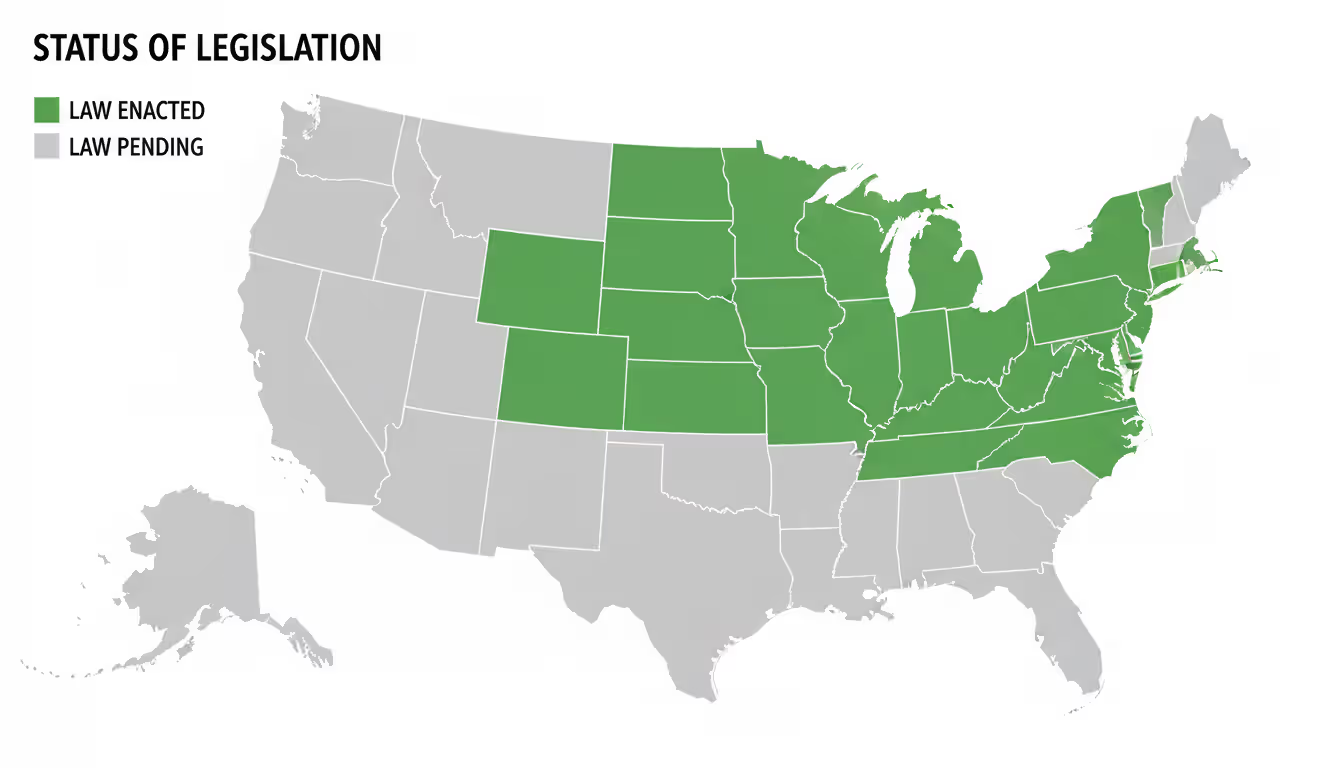
As of 2026, twenty-nine states plus Washington D.C. have enacted versions of the Uniform Partition of Heirs Property Act. Adoption accelerated after 2020 as awareness grew about generational wealth loss through partition abuse.
State
Year Adopted
Key Modifications
Statute Citation
Alabama
2014
Standard version
Ala. Code § 35-6A-1
Arkansas
2017
Adds mediation requirement
Ark. Code § 18-60-1001
California
2022
Expanded definition of heirs property
Cal. Civ. Proc. Code § 874.311
Connecticut
2016
Standard version
Conn. Gen. Stat. § 52-500
Florida
2020
Additional notice requirements
Fla. Stat. § 64.201
Georgia
2012
First state to adopt
Ga. Code § 44-6-160
Hawaii
2018
Standard version
Haw. Rev. Stat. § 668-1
Illinois
2022
Enhanced buyout procedures
735 ILCS 5/17-101
Maryland
2019
Standard version
Md. Code Real Prop. § 14-101
Mississippi
2018
Agricultural land provisions
Miss. Code § 89-1-501
Montana
2017
Standard version
Mont. Code § 70-30-501
Nevada
2015
Standard version
Nev. Rev. Stat. § 39.400
New Mexico
2019
Standard version
N.M. Stat. § 42-3A-1
New York
2019
Standard version
N.Y. Real Prop. Acts. § 993
North Carolina
2023
Standard version
N.C. Gen. Stat. § 46A-1
Oregon
2024
Standard version
Or. Rev. Stat. § 105.820
South Carolina
2019
Standard version
S.C. Code § 15-61-315
Texas
2017
Community property considerations
Tex. Prop. Code § 23A.001
Virginia
2020
Standard version
Va. Code § 8.01-81.1
West Virginia
2023
Standard version
W. Va. Code § 37-17-1
States currently considering legislation include Kentucky, Louisiana, and Pennsylvania, where heirs property issues significantly affect rural communities. Advocacy groups are pushing for adoption in these jurisdictions.
Author: Marcus Delane;
Source: redmonpestmgt.com
In states without the Act, old partition rules still apply. Any co-owner can force a sale without buyout opportunities or appraisal protections. Families in these states face higher risks of losing inherited property involuntarily.
How the Partition Process Works Under the Act
Understanding the step-by-step procedure helps families navigate partition disputes strategically.
Step 1: Petition filing. One co-owner files a partition complaint in the county where the property sits. The petition must identify all co-tenants, describe the property, and explain the ownership interests. Under the Act, the petitioner must state whether the property qualifies as heirs property—real estate owned by co-tenants as tenants in common, with at least one owner related to another, and acquired through intestate succession or will from a relative.
Step 2: Service and response. All co-owners receive formal notice of the partition action. They typically have 30 days to respond, stating whether they oppose partition and whether they want to exercise buyout rights.
Step 3: Determination of heirs property status. The court decides if the Act applies. If the property qualifies as heirs property, the Act's protections kick in. If not, traditional partition rules may govern.
Step 4: Court-ordered appraisal. The court appoints a qualified appraiser who inspects the property and determines fair market value. The appraisal timeline runs 30-60 days depending on property complexity. All parties receive copies of the appraisal report.
Step 5: Buyout negotiation period. Co-tenants who want to keep the property can offer to purchase the shares of those seeking partition. Offers must equal or exceed the appraised value multiplied by the ownership percentage. If multiple co-owners want to buy out the petitioner, they can combine their offers.
The court supervises negotiations, setting deadlines for offers and acceptance. If buyout agreements succeed, the partition case ends with a property transfer instead of division or sale.
Step 6: Partition in kind consideration. When buyouts fail, the court evaluates whether the property can be physically divided. Commissioners or surveyors may assess division feasibility. Courts weigh factors like:
Step 7: Partition by sale (if necessary). Only when partition in kind is impractical does the court order a sale. The property lists with a broker at or above appraised value for at least 90-120 days. Marketing must include MLS listings, signage, and reasonable advertising.
If the property sells through broker marketing, proceeds are distributed to co-owners according to their ownership percentages after costs. If it doesn't sell, the court may order an auction—but with a reserve price preventing sales below a percentage of appraised value (typically 80%).
Factor
Partition in Kind
Partition by Sale
Process
Physical division into separate parcels
Property sold; proceeds divided
Timeline
6-12 months including surveying
9-18 months including marketing period
Cost Factors
Survey costs, legal fees, recording fees
Broker commissions, legal fees, closing costs
When Ordered
Property can be fairly divided without value destruction
Division impractical or unfair; no buyout agreement
Pros
Preserves family ownership; no forced sale
Provides liquidity; clean break for disputing parties
Cons
May create smaller, less valuable parcels
Family loses property; emotional/historical loss
Costs and Timeline Expectations
Partition actions aren't cheap. Appraisal costs range from $500 for simple residential property to $5,000+ for large farms or commercial land. Attorney fees run $3,000-$15,000 depending on case complexity and whether parties cooperate or fight.
Survey and subdivision costs for partition in kind add another $2,000-$10,000. If the case goes to trial with expert witnesses, costs escalate quickly.
Timeline varies by court congestion and case complexity. Uncontested partitions with successful buyouts might resolve in 4-6 months. Contested cases involving appraisal disputes, partition in kind evaluations, and eventual sales can stretch 18-24 months.
Author: Marcus Delane;
Source: redmonpestmgt.com
Strategies for Protecting Your Family Land
Prevention beats litigation. Families can avoid heirs property problems through proactive planning.
Create a will. The simplest solution is ensuring property passes through a will or trust rather than intestate succession. A will designates who inherits property and in what shares, preventing automatic tenancy in common situations.
Establish family LLCs or trusts. Transferring property into a limited liability company or family trust creates a management structure with defined decision-making rules. The LLC operating agreement or trust document specifies how the property is maintained, who manages it, and how ownership interests can be transferred. This prevents individual heirs from unilaterally forcing partition.
Draft co-ownership agreements. When multiple heirs inherit property, a written agreement can establish ground rules. The agreement might include:
Right of first refusal (other co-owners can buy before outside sales)
Dispute resolution procedures (mediation before litigation)
Cost-sharing formulas for taxes, maintenance, insurance
Maintain clear records. Document all ownership interests, property tax payments, and improvements. Confusion about who owns what percentage often triggers partition disputes.
Communicate early and often. Family meetings about inherited property—before conflicts arise—help align expectations. Discuss whether everyone wants to keep the property, what it means to the family, and how to handle disagreements.
Consult attorneys experienced in heirs property. General practice lawyers may not understand the unique issues. Seek attorneys familiar with inherited land dispute resolution and the Uniform Partition of Heirs Property Act in your state.
Consider life estate arrangements. Parents can transfer property to children while retaining a life estate, giving them the right to live on or use the property until death. This begins the ownership transition while parents are alive to guide decisions.
Author: Marcus Delane;
Source: redmonpestmgt.com
Frequently Asked Questions
Can one heir force the sale of inherited property?
Yes, but the process differs depending on whether your state adopted the Uniform Partition of Heirs Property Act. In states with the Act, other heirs have buyout rights and the court must consider partition in kind before ordering a sale. The property must be appraised and marketed at fair value. In states without the Act, one heir can more easily force a quick auction sale.
How is fair market value determined under the Act?
The court appoints an independent, licensed appraiser who inspects the property and prepares a formal appraisal report. The appraiser considers comparable sales, property condition, location, and highest-and-best use. All co-owners receive the appraisal, and they can challenge it if they believe it's inaccurate. The court may order a second appraisal if disputes arise.
What happens if I can't afford to buy out other heirs?
You have several options. First, multiple family members can pool money to buy out the heir seeking partition—you don't have to purchase the entire share alone. Second, you might secure financing using the property as collateral, though this can be difficult with heirs property. Third, you can propose a payment plan, though the selling heir must agree. If none of these work, the partition will proceed, potentially resulting in division or sale.
Does the Act apply to property inherited before it was passed?
Yes. The Act applies to partition actions filed after the state's adoption date, regardless of when the property was inherited. If your state adopted the Act in 2020, a partition case filed in 2026 receives the Act's protections even if the property was inherited in 2005. The Act governs the procedure, not the underlying property rights.
How long does a partition case take under the Act?
Expect 9-18 months for most cases. The timeline includes appraisal (1-2 months), buyout negotiation period (2-3 months), partition in kind evaluation if needed (2-4 months), and marketing period for sales (3-6 months). Complex cases with multiple disputes, appeals, or difficult properties can extend beyond two years.
Do I need an attorney for a partition action?
Strongly recommended. Partition cases involve complex property law, court procedures, and significant financial stakes. An attorney protects your rights, ensures you understand buyout options, helps negotiate with other heirs, and advocates for partition in kind if you want to preserve the property. The cost of hiring an attorney is usually far less than the value you might lose without proper representation.
The Uniform Partition of Heirs Property Act represents a fundamental shift in how American law treats inherited family land. By requiring appraisals, creating buyout opportunities, and prioritizing physical division over forced sales, the Act protects families from exploitation while respecting the legitimate rights of co-owners who want to exit shared ownership.
If you've inherited property with siblings or other relatives, understand your state's partition laws. In the twenty-nine states that adopted the Act, you have significant protections against losing family land at unfair prices. In states without the Act, proactive estate planning and family agreements become even more critical.
The best strategy is preventing heirs property situations altogether through wills, trusts, and clear succession planning. But when you find yourself in a partition dispute, knowing your rights under the Uniform Partition of Heirs Property Act can mean the difference between preserving generational wealth and watching your family's land disappear at auction.
Zoning regulations determine what you can build and where across the United States. This guide explains zoning law basics, classification types, how to find zoning information, navigate variances and permits, and address alternative structures like shipping containers
Trespassing represents one of the most common property violations in the US. Learn the legal definitions, differences between criminal and civil trespass, penalties, proper signage requirements, and how property owners can legally protect their land from unauthorized entry
Real estate fraud costs Americans hundreds of millions annually through wire transfer scams, forged deeds, and foreclosure rescue schemes. This comprehensive guide explains common fraud types, warning signs to watch for, and practical prevention steps to protect your property and finances during transactions
Co-owning property with family members, business partners, or former spouses can become complicated when disagreements arise about selling, managing, or dividing the asset. When negotiations fail and co-owners reach an impasse, a partition action provides a legal remedy to force the division or sale of jointly owned real estate
The content on this website is provided for general informational and educational purposes only. It is intended to explain concepts related to real estate law, property rights, leases, liens, zoning, landlord-tenant disputes, and litigation.
All information on this website, including articles, guides, and examples, is presented for general educational purposes. Legal outcomes may vary depending on jurisdiction, property type, and individual circumstances.
This website does not provide legal advice, and the information presented should not be used as a substitute for consultation with qualified attorneys or real estate professionals.
The website and its authors are not responsible for any errors or omissions, or for any outcomes resulting from decisions made based on the information provided on this website.